
Insights · September 2026
First mortgage, second mortgage and mezzanine: what your ranking actually buys you
Around 40 private credit funds lent money to Bathla. Every one of them was secured. They will not be repaid the same way, and the reason has very little to do with how good their managers are.

Cathy Howard · Skyring Asset Management · 23 September 2026
Skyring Asset Management has no association with Bathla Group, Universal Property Group, Raj & Jai Construction or any of their related entities, and is not a lender to them. Nothing in this article should be read as suggesting otherwise.
On 18 September the NSW Supreme Court gave Bathla's administrators up to another twelve months to convene the second creditors' meeting. They have $4.7 million in interim funding, around 660 lots under pre-sale contract, 1,974 still unsold, and no long-term funding arrangement yet. Roughly $3.4 billion is owed to private lenders.
Here is the part that gets lost. The question of who among those lenders gets repaid, and in what order, was settled before the first dollar left anyone's account. It was settled by ranking, which is a legal position recorded on a title, and it will not be renegotiated by anyone's relationship with the borrower or anyone's skill at working out a distressed loan.
I think ranking explains more of the return difference between Australian credit funds than manager skill does, and that almost nobody markets it that way. A fund charging for skill while the yield is really coming from subordination is selling you something other than what it says on the tin. This piece is about how to tell the difference.
This is the first of two parts. The second walks a single development loan through a failure and shows what each lender in the stack actually recovers.
The word doing the least work in your fact sheet
Secured. It appears on nearly every private credit fact sheet in the country and on its own it tells you close to nothing.
A loan is secured when the lender holds a legal interest in an asset that can be sold to repay the debt. That is all the word promises. It says nothing about how many other lenders hold an interest in the same asset, or who gets paid first out of the sale proceeds, or how much of the asset's value has to survive before your dollar comes back. Two funds can both describe themselves as secured against the same building and sit in positions so different that one carries a materially lower risk profile and the other a materially higher one.
The industry knows this. ASIC's private credit surveillance report, published in November 2025 after examining 28 funds, found managers mischaracterising products as low risk, obscuring fees and interest margins, and running inconsistent definitions of what counts as a default. Ranking disclosure sits in the same family of problems. It is technically there in the offer document and practically invisible to the person reading it.
What the capital stack actually is
Every property development is funded by a pile of money assembled from different sources, and each source agrees in advance to be repaid in a particular order. That ordering is the capital stack, and it runs from safest at the bottom to riskiest at the top.
First mortgage, also called senior debt. The lender registers a first-ranking mortgage over the property. When the property is sold, this lender is repaid before any other lender, out of the proceeds, after the costs of the sale itself. In Australia most first mortgage development lending sits somewhere between 55% and 70% of the property's value.
Second mortgage. A different lender registers a mortgage over the same property, behind the first. The second mortgagee gets paid only after the first has been repaid in full, including all accrued interest and enforcement costs. The security is real and the recovery is contingent on there being something left.
Mezzanine. Debt that sits above both mortgages, sometimes secured by a charge over the borrowing entity rather than the land itself, sometimes by a third-ranking mortgage. Mezzanine lenders are paid after the mortgage holders and before the developer's own money. The rate is high because the position is thin.
Preferred equity and developer equity. This money is repaid last and absorbs the first losses. In a bad project it is gone before anyone in the debt stack takes a cent of pain.
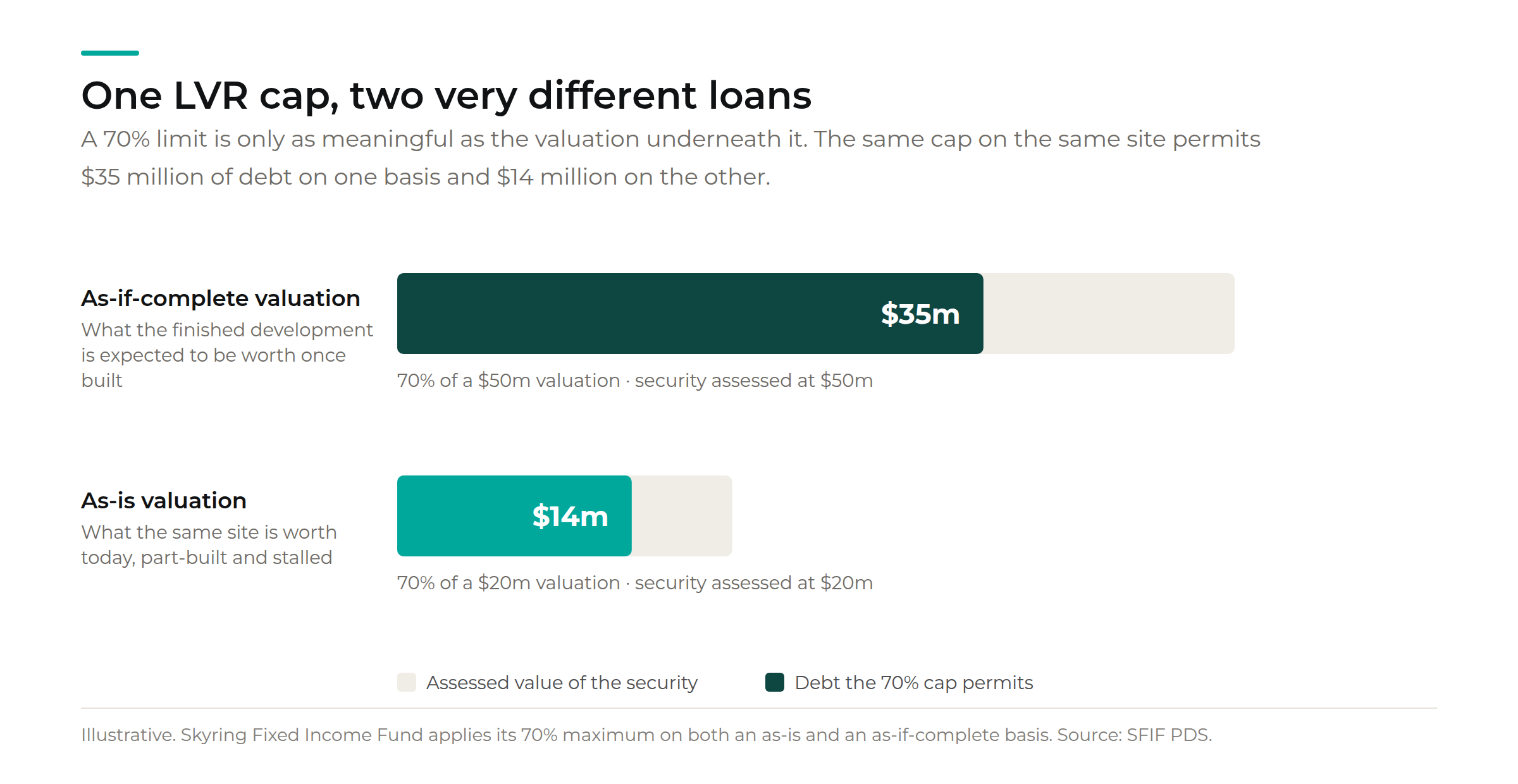
Two pieces of jargon that decide a lot and get skipped over. Lending valuation ratio (LVR) is the loan amount divided by the value of the security. As-if-complete valuation is what the finished development is expected to be worth, as opposed to as-is, which is what the site is worth today with a half-built frame on it. A 70% LVR calculated against an as-if-complete figure and a 70% LVR calculated against an as-is figure describe very different amounts of protection, and a fact sheet that quotes a single LVR number without saying which basis it used has told you almost nothing.
The order of payment when a project fails
When a borrower defaults and the security property is sold, the proceeds are distributed in a fixed sequence. Roughly:
First, the costs of realisation. Receiver's fees, agent's commission, legal costs, rates and land tax arrears. On a stalled development these are not trivial, because a receiver often has to spend money to make the asset saleable at all.
Second, the first mortgagee's principal, all interest accrued since the borrower stopped paying, default interest where the loan documentation permits it, and the lender's own enforcement costs.
Third, the second mortgagee, in the same order of principal, accrued interest and costs.
Fourth, mezzanine.
Last, equity.
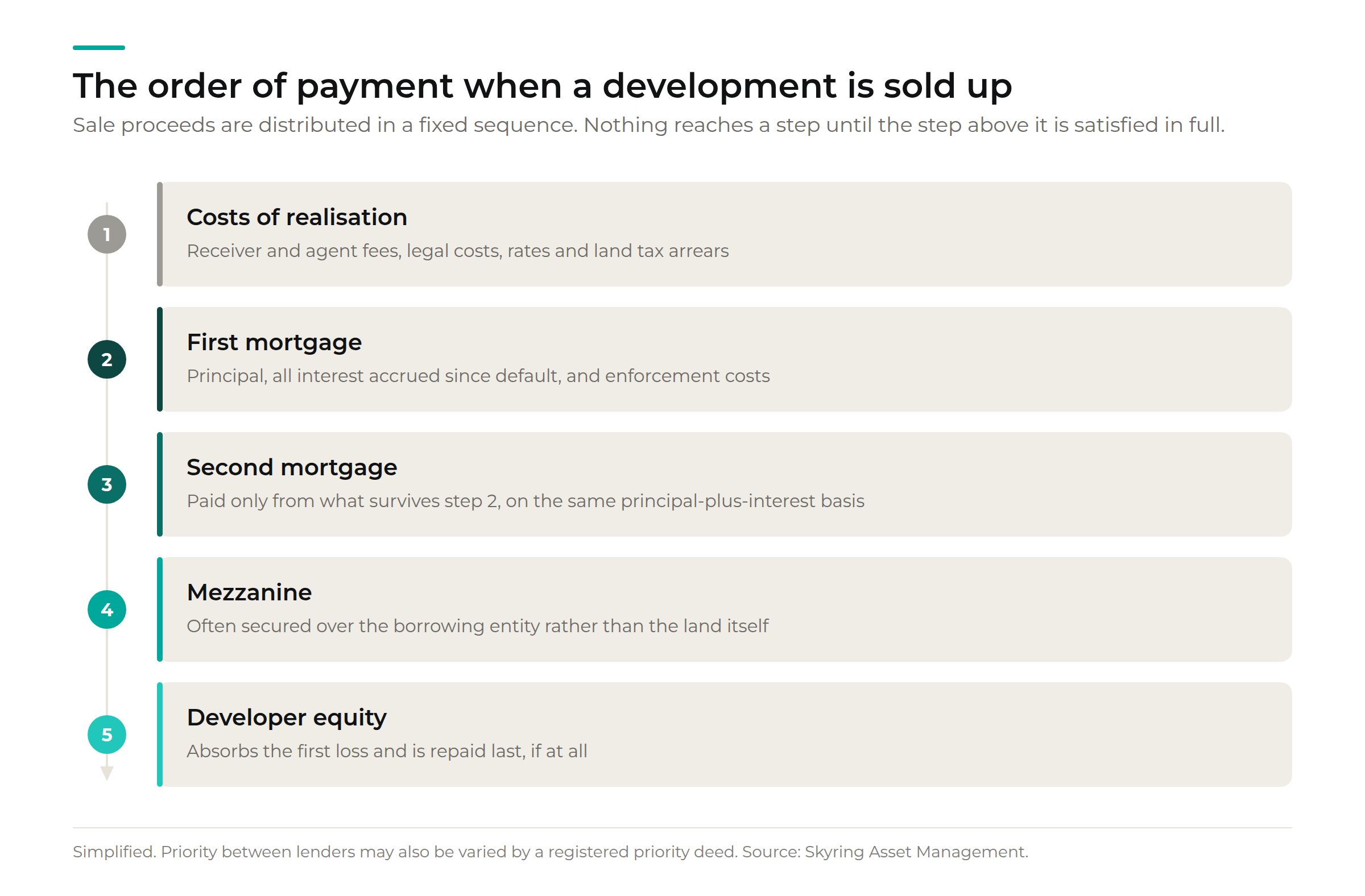
The sequence is the whole story, and it has a property that catches people out. Interest keeps running on the senior position throughout the workout, whether or not the borrower pays it. Every month the project sits unsold, the amount the first mortgagee is owed goes up, and the amount available to everyone below it goes down. A twelve month administration moves value steadily toward the senior lender, month by month, at the senior interest rate.
We have run this experiment before
The GFC did this to Australian mortgage funds at scale. Between late 2008 and 2010 a long list of them froze redemptions, and the funds that eventually returned capital in full were overwhelmingly the ones that had lent first-ranking against completed income-producing assets. The funds that lent into development, and particularly those that lent behind someone else, returned cents. The managers were not uniformly worse. Their positions were.
Evergrande made the same point on a scale Australia has never seen. When the group was ordered into liquidation, its offshore bondholders discovered that their claims sat structurally behind the onshore secured creditors who had direct claims on the project companies and the land. Recovery estimates for that offshore paper fell to the low single digits of cents in the dollar. Those bonds had paid a fat coupon for years. The coupon was compensation for a structural position that most holders had not priced.
Skyring's article on the Bathla collapse covers who is exposed there and how the administration is likely to unfold. What that piece could not do, because the information is not public, is tell you where each of those 40 lenders sits. That is the point. From the outside, you often cannot.
Four things your ranking will not protect you from
Time
A first mortgage at 60% LVR looks comfortable until you ask how long it takes to get the money back. Enforcement in Australia runs on court timetables and market conditions, and a stalled development with pre-sale contracts attached is not a quick sale. Bathla's administrators asked for twelve months and gave a reason worth reading twice: the records were scattered across “different systems, staff emails, network drives and hard-copy records” with no central repository. During that period, income stops and interest accrues.
The cost of enforcement
Receivers, agents, lawyers and quantity surveyors all get paid before the first mortgagee sees a dollar, and on a part-built site the receiver may need to spend real money on securing, insuring and sometimes completing works. On a small development these costs can consume several percentage points of gross proceeds, which comes straight out of whatever cushion the LVR was supposed to provide.
The vintage of the valuation
An LVR is only as current as the valuation underneath it. A 65% ratio struck against a valuation done two years ago, in a market where national values have been falling and house construction costs sit 51% above pre-COVID levels, may be a 78% ratio today. This is why the frequency and independence of revaluation matters more than the headline number, and why valuer rotation is a lending policy detail worth asking about rather than skipping.
The definition of the ratio you were quoted
Drawn balance or approved limit. As-is or as-if-complete. Does the calculation include debt ranking ahead of the fund's own position, or only the fund's slice? A second mortgage of $5 million behind a $28 million first, against a $50 million valuation, is either a 10% LVR or a 66% LVR depending on which convention the manager uses, and both numbers have appeared in Australian marketing material.
What this means for your portfolio
1.Establish your ranking before you look at the rate
Find the lending policy section of the offer document, not the fact sheet, and read what the fund is permitted to do rather than what it currently does. The language is usually precise once you know what you are reading for.
The Skyring Fixed Income Fund PDS states that the lender will only provide first-ranking or senior debt loans and will not provide second-ranking or mezzanine loans, with a maximum LVR of 70% on both an as-is and an as-if-complete basis. The Skyring Platinum Fixed Income Fund permits senior and mezzanine lending to a maximum 80% on an as-if-complete basis and counts any prior-ranking debt when calculating its own ratio. Its supplementary PDS dated 12 February 2026 revised the second-ranking lending policy, removing the requirement that the first-ranking loan be advanced by Skyring Securities or a related company. The provider of a first-ranking loan can now be any lender approved by Skyring Securities.
That last point is worth sitting with, because it cuts against the direction you might expect. Widening the pool of acceptable senior lenders is a loosening, and a fund that discloses a loosening in a supplementary document rather than burying it is doing the thing this article is asking you to look for. Each of those parameters is separately checkable. If the fund you hold cannot produce equivalent sentences from its own documents, that absence is your answer.
2.Read the definition, not the number
Ask the manager which valuation basis the quoted LVR uses, whether it is struck on drawn balance or facility limit, how the portfolio figure is weighted, and when the underlying valuations were last refreshed. Ask whether second-ranking positions are reported separately from first-ranking ones, because a blended average across both hides exactly the thing you are trying to see.
A manager who answers these quickly and without qualification is telling you they have the data. A manager who takes a week, or who sends a marketing document instead of an answer, is also telling you something.
3.Decide what your defensive allocation is actually for
This is where the ranking question stops being technical. Money in the defensive part of a portfolio is doing a specific job. It is meant to keep paying income and holding its value when the growth assets are having a bad year, which is precisely the environment in which a subordinated credit position performs worst. A mezzanine holding paying 15% is a fine thing to own, and it is not defensive, because its outcomes correlate with exactly the conditions you were holding defensive assets to survive.
The Australian bond market has just given investors a live demonstration of the same principle in reverse. The 10-year government bond reached 5.31% in September, its highest since 2011, which means anyone who bought long-dated government paper at 0.55% in 2020 has worn a capital loss on an asset everyone described as safe. Duration was a risk that was never labelled as one. Subordination is the same kind of unlabelled risk, sitting in a different part of the portfolio.
If you want a fuller treatment of how the different fixed income sleeves behave against each other, Skyring's guide to government bonds, corporate bonds and secured lending is the companion piece to this one. The short version is that actively managed fixed income earns its place in a portfolio through the discipline in the lending policy rather than the number on the front of the fact sheet, and ranking is the single largest component of that discipline.
The bottom line
Secured is a category, not a grade. Within it sits a range of positions that behave so differently under stress that treating them as one asset class is a mistake. The first mortgagee in a failed development may wait two years and take a modest haircut. The mezzanine lender in the same deal, paid nearly double the rate for the same borrower and the same building, may recover nothing at all. Neither outcome reflects how clever the manager was. Both were determined by a line on a title registered before construction started.
If you hold private credit and cannot say, in one sentence, where in the capital stack your money sits and what percentage of the property's value would need to be lost before you are affected, that is the gap worth closing this month. Part two takes a single development loan through a default and puts numbers against every position in the stack, including the one you are probably in.
FAQ
What is the capital stack?
The ordered list of everyone who has put money into a property project, arranged by who gets repaid first when the asset is sold. Senior debt is repaid first and equity last.
Is a second mortgage still secured?
Yes. A registered second mortgage is a genuine legal interest in the property. It simply ranks behind the first mortgage, so it is repaid only from whatever is left after the first mortgagee has recovered principal, accrued interest and enforcement costs in full.
Why do mezzanine loans pay so much more?
Because they sit near the top of the stack, where losses are absorbed first. The additional interest is compensation for a materially higher chance of partial or total loss, not a reward for finding a better deal.
How do I find out where my fund sits?
Read the lending policy section of the PDS rather than the fact sheet. It will state whether the lender may provide second-ranking or mezzanine loans, what the maximum LVR is, and on what valuation basis that ratio is calculated.
Does a low LVR mean my money is safe?
It means there is a buffer between the loan and the property's value at the date of the valuation. It does not address how long recovery takes, what enforcement costs consume, or whether that valuation is still accurate.
What does as-if-complete mean?
The valuer's estimate of what the finished development will be worth once built. An as-is valuation is what the site is worth in its current condition. Development lending is often measured against the as-if-complete figure, which is a larger number and therefore produces a lower-looking ratio.
Why does a long administration hurt junior lenders most?
Interest continues to accrue on the senior debt throughout. Each month of delay increases what the first mortgagee is owed and reduces what is available to everyone ranking behind it.
Should I avoid subordinated credit entirely?
That is a question about your own circumstances and objectives, and it is not one this article can answer for you. The point here is narrower. Whatever you hold, you should be able to state your position in the stack, and you should not count a subordinated position as part of the defensive portion of your portfolio.
Are Australian regulators doing anything about this?
ASIC completed a surveillance of 28 private credit funds and published its findings in November 2025, identifying weaknesses in valuation governance, fee transparency, conflict management and credit risk practices. The Financial Services Council has since issued an industry standard covering similar ground, effective from 1 July 2027.
References
- ABC News, Bathla administrators win more time as funding talks continue, 18 September 2026.
- ABC News, Australia has a housing shortage. So why are Bathla and other home builders collapsing?, 8 September 2026.
- ABC News, ASIC warns of 'first significant cracks' in Australian private credit, 27 August 2026.
- Alternative Credit Investor, Property developer Bathla collapse rattles Australian private credit, 4 September 2026.
- ASIC, REP 820: Private credit surveillance report, 5 November 2025.
- Ashurst, Closing the gap: FSC sets new industry standards for private credit, August 2026.
- Fortune, Evergrande liquidation: Western hedge funds face a 99% haircut, 8 February 2024.
- YieldReport, Australian bond yields, 10 September 2026.
- Skyring Asset Management, Skyring Fixed Income Fund Product Disclosure Statement.
- Skyring Asset Management, Skyring Platinum Fixed Income Fund Product Disclosure Statement.
- Skyring Asset Management, What happened to Bathla? Who's to blame, who's exposed, and what it means for Australian investors, 31 August 2026.
- Skyring Asset Management, Corporate Bonds vs Government Bonds vs Secured Lending, 26 May 2026.
Important Information
This blog post is for general information only and does not consider your personal circumstances, financial needs, or objectives. You should read the Product Disclosure Statement carefully before investing. Past performance is not a reliable indicator of future results. Investments carry risks including possible loss of capital. No guarantee is made regarding the repayment of capital or the payment of income.
As with all investments, returns are subject to market conditions and the performance of the underlying assets.
This rate of return is subject to the performance of our related entity, Skyring Capital Pty Ltd and/or Skyring Securities Pty Ltd.
You should consider whether the investments are suitable for you or seek personal advice from a licensed financial planner before making an investment decision.
To invest in this Offer, investors should obtain and read the PDS, SPDS and TMD before making an investment decision. TMD, SPDS and PDS for this product are available from our website or request a copy by contacting us on 1300 73 72 74 or request one from your Financial Advisor. Investments may only be made by completing the application form attached to the Product Disclosure Statement or via our online application service.
Skyring Asset Management Limited ACN 156 533 041 holds Australian Financial Services License (AFSL) 422902. Skyring has registered the Skyring Fixed Income Fund ARSN 622 775 464 with the Australian Securities and Investments Commission (ASIC). Skyring Asset Management Limited ACN 156 533 041 AFSL 422902 is the issuer and manager of the Skyring Fixed Income Fund ARSN 622 775 464. Skyring has registered the Skyring Platinum Fixed Income Fund ARSN 646 317 982 with the Australian Securities and Investments Commission (ASIC). Skyring Asset Management Limited ACN 156 533 041 AFSL 422902 is the issuer and manager of the Skyring Platinum Fixed Income Fund ARSN 646 317 982.
Withdrawal rights are subject to liquidity and may be delayed or suspended. See PDS and SPDS for more information.
Skyring's address is Level 2, 2 Gardner Close, Milton, QLD, 4064. Our reply-paid postal address is Reply Paid 88076, Kenmore, QLD 4069. You can contact us by telephone on 1300 73 72 74 or via email at investor@skyring.com.au.