
What happened to Bathla? Who’s to blame, who’s exposed, and what it means for Australian investors
A $3.3 billion developer has run out of cash in the middle of building 2,000 homes, and around 40 private credit funds are now finding out what their loan books are actually worth. The lesson for investors has less to do with property than with how the money was lent.
Last week, the administrators of Bathla Group told reporters they had borrowed a million dollars from their own head office so the business could pay for petrol, vehicle registrations and, in Teneo’s phrasing, keep the lights on. Around 350 staff had gone eight weeks without wages. Roughly 219 construction sites across New South Wales were sitting in various states of half-finished.
That is an unusual position for a company that, on paper, was one of Sydney’s most prolific residential developers, with something like $3.2 billion of liabilities recorded in its most recent filings and a pipeline of more than 13,000 dwellings.
It is also, for anyone holding a mortgage fund or a private credit product in their portfolio, the most instructive event in Australian credit markets in several years. So it’s worth going slowly through what happened, because the story that has been told publicly and the story the numbers tell are not quite the same.
What actually happened
Bathla Group, which operates through Universal Property Group and a web of related vehicles, was founded in 1997 by Bhart Bhushan, a former taxi driver, and built its business on affordable housing in Sydney’s west and south-west. Townhouses, duplexes, low-rise apartments, the kind of stock that sells to first home buyers and investors chasing yield rather than prestige.
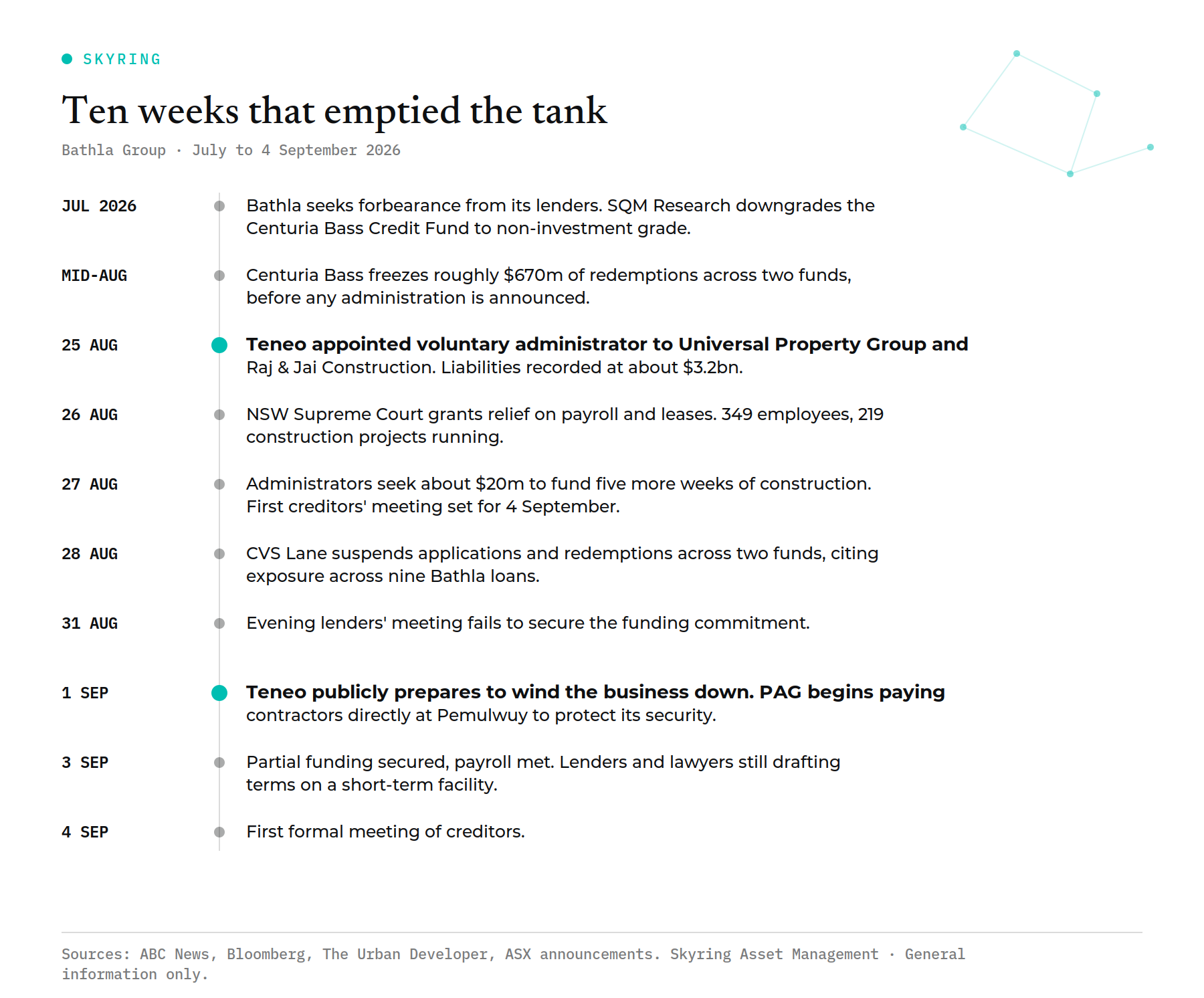
On 25 August 2026, Teneo was appointed voluntary administrator to Universal Property Group and the group’s internal building arm, Raj & Jai Construction. Managing director Bhart Bhushan described the appointment as the clearest pathway to putting the group on a sustainable footing, and attributed the situation to a combination of softening sales, the May federal budget and rising construction costs. Chief executive Robert Loader said the business had been through a period of falling sales and property prices while costs went up.
What followed was less orderly than the word “restructure” suggests. Within days the administrators disclosed that the group had no cash to pay wages or suppliers, and went looking for roughly $20 million just to keep sites moving for five weeks. A lenders’ meeting on the evening of Monday 31 August failed to produce that money, and by Tuesday morning Teneo was publicly preparing to wind the business down. As at today, a partial funding package has been assembled and payroll has been met, and lenders and their lawyers are still drafting terms on a short-term facility. The first formal meeting of creditors is scheduled for 4 September, where creditors will eventually choose between a deed of company arrangement and liquidation.
The position remains precarious, and anything written about Bathla this week carries a short shelf life.
The part of the model that mattered
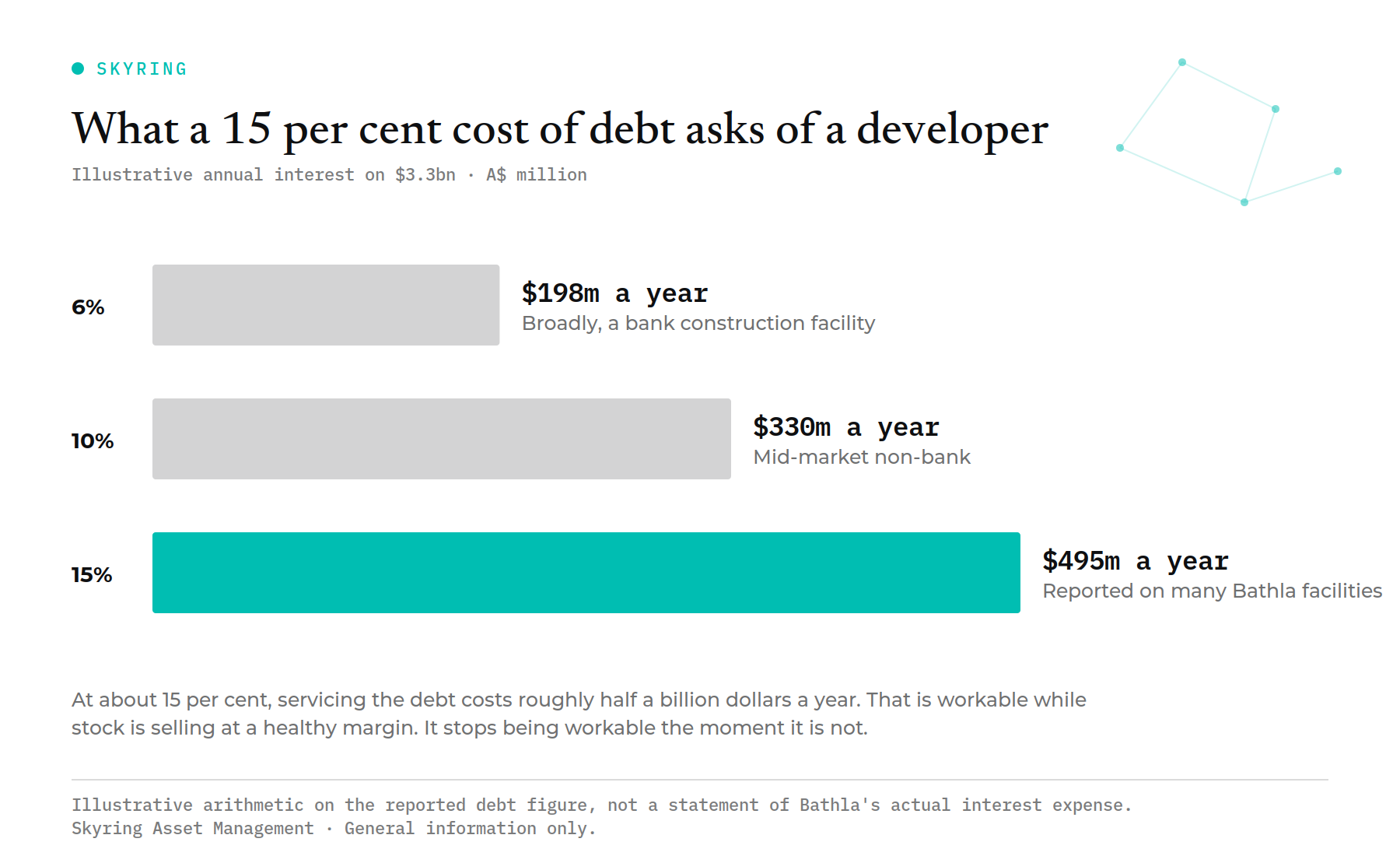
Here is the detail that explains more than the budget does. Bathla financed itself almost entirely outside the banking system, across land loans, construction loans and residual stock loans, and it paid for the privilege. Bloomberg reports that many of those facilities carried returns of around 15 per cent a year, with personal guarantees from Bhushan attached to some of the debt.
Fifteen per cent is not a normal cost of funds for a residential developer. It is the price of capital for a borrower that banks will not take, or will not take at that scale and pace, and it only works if the sales keep coming and the margin on each project stays wide enough to service it.
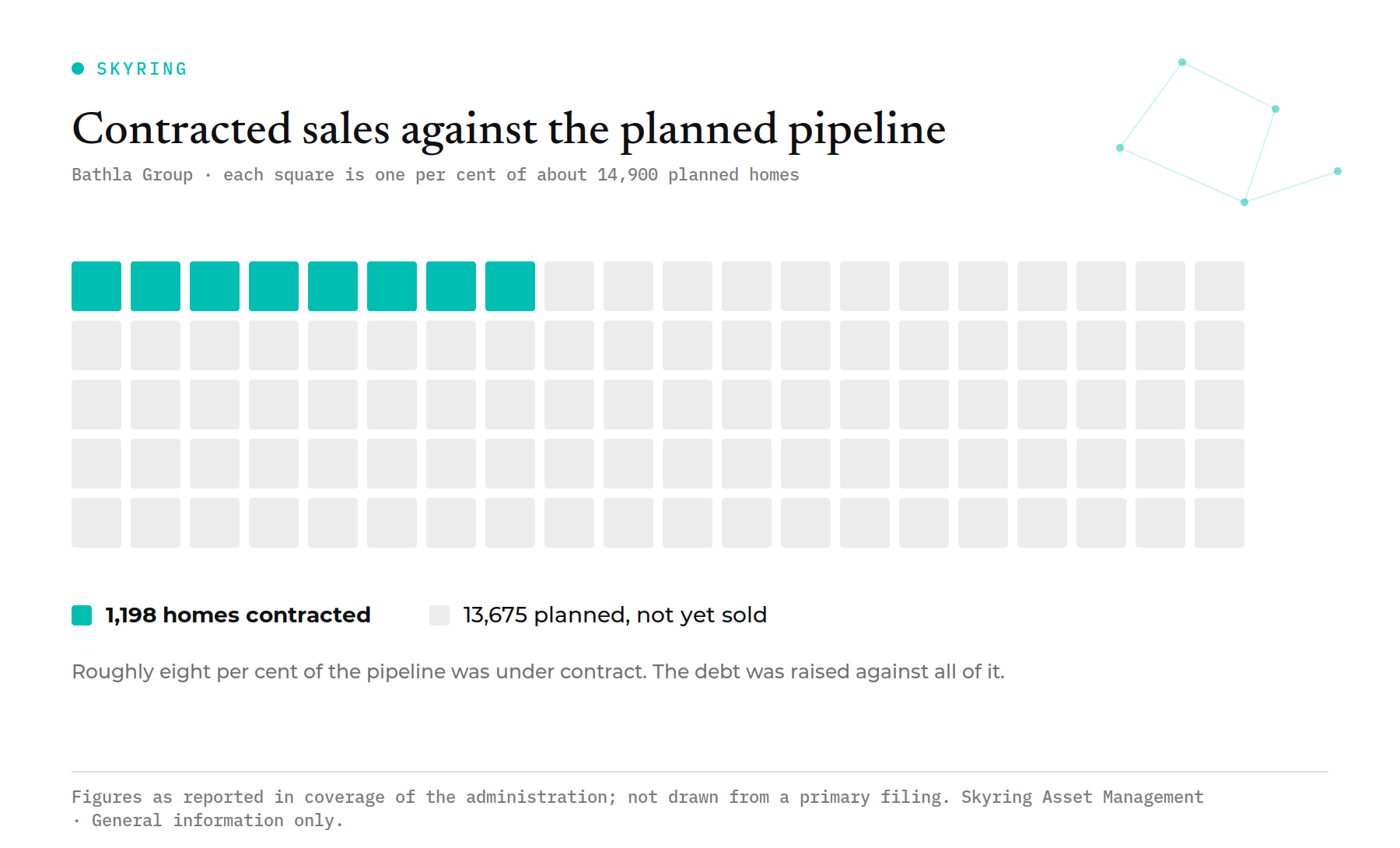
The sales did not keep coming. Reporting on the group’s position suggests Bathla had secured somewhere around 1,198 sales against a planned pipeline of close to 14,900 homes, and that a single project at Marsden Park carried a cost blowout of about $25 million. Once construction inflation ate the development margin, a 15 per cent funding cost stopped being expensive and started being terminal. The group sought forbearance from its lenders in July, a month before anyone outside the industry knew there was a problem.
So who is to blame?
The company’s own explanation points to a perfect storm: falling confidence, higher build costs, and the tax changes announced in the 2026 federal budget. Two of those three are plainly true. Construction costs have been punishing for four years, and confidence in outer-suburban house and land has been soft since rates started rising.
The budget explanation deserves more scepticism than it has received. The changes announced on 12 May limit negative gearing on residential property to new builds from 1 July 2027, while eligible new builds keep both negative gearing and the 50 per cent CGT discount. Bathla sold new stock. On the face of the policy, it sits on the favoured side of the line. There is a real argument that the broader uncertainty around the package, including the trust and CGT measures, chilled investor activity across the board for months while the detail was worked through, and that is a genuine effect. But The Australian has reported that the group’s troubles were visible before the budget was handed down, and the sales-to-pipeline gap suggests a business that had outrun its own market well before May.
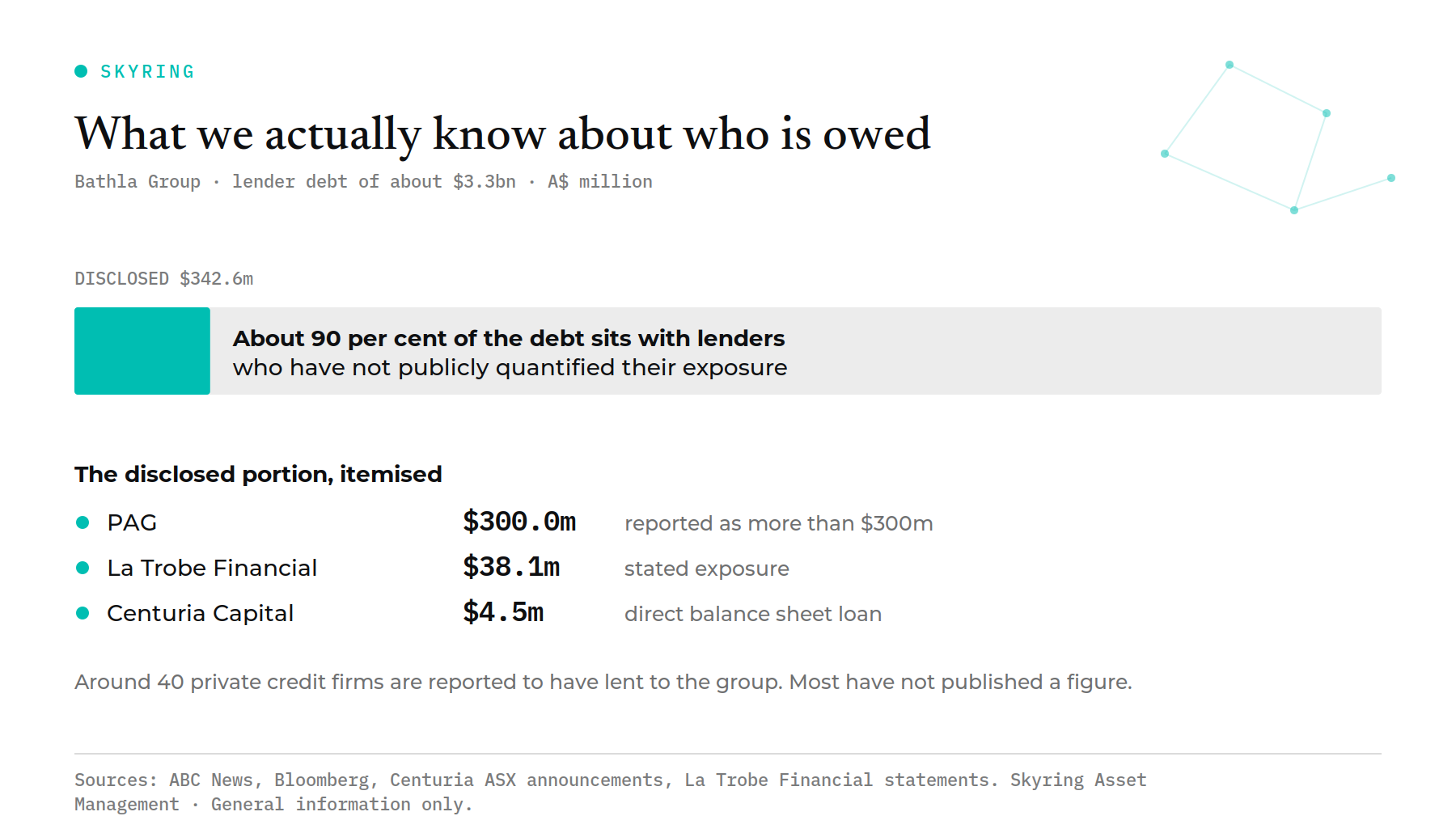
The more honest answer is that responsibility is distributed, and most of it sits with the capital stack rather than with Canberra. Something close to 40 private credit firms lent to this borrower. Many of them were lending against the same regional housing market, against the same builder, on similar assumptions about how quickly product would sell. The concentration risk was not hidden. It was simply spread across enough separate funds that no single manager had to look at it whole.
ASIC has been saying a version of this for eighteen months. Its 2025 surveillance of 28 private credit funds, published as REP 820, found that fewer than half had written policies for managing impairments or defaults, that most lacked meaningful separation between the people approving loans and the people valuing them afterwards, and that construction loans were routinely valued on as-if-complete assumptions that understate risk while a project is still in the ground. The regulator made poor private credit practices a 2026 enforcement priority and told the sector in June to make sure its 30 June valuations were current and realistic. Chair Sarah Court has since described the present conditions as the sector’s first real test.
None of that is a reason to write off private credit as an asset class. It is a reason to be precise about which operators were doing the work and which were collecting a margin for taking a view somebody else had already taken.
Who is exposed
The exposure runs in layers, and they behave very differently.
The lenders. PAG, one of Asia’s larger private investment firms, is reported to have more than $300 million out. CVS Lane told investors it had exposure across nine separate loans. Centuria Bass has six loan facilities to the group, two of them construction facilities, and its parent disclosed a $4.5 million direct balance sheet loan that it does not expect to be material. La Trobe Financial has put its exposure at approximately $38.1 million. Balmain, Ray White Capital, Keyview, Trilogy, Credit Connect, MaxCap and Wingate are among the other names in the register. Several have said publicly that they expect full recovery, and for first mortgage holders on projects near completion that is plausible.
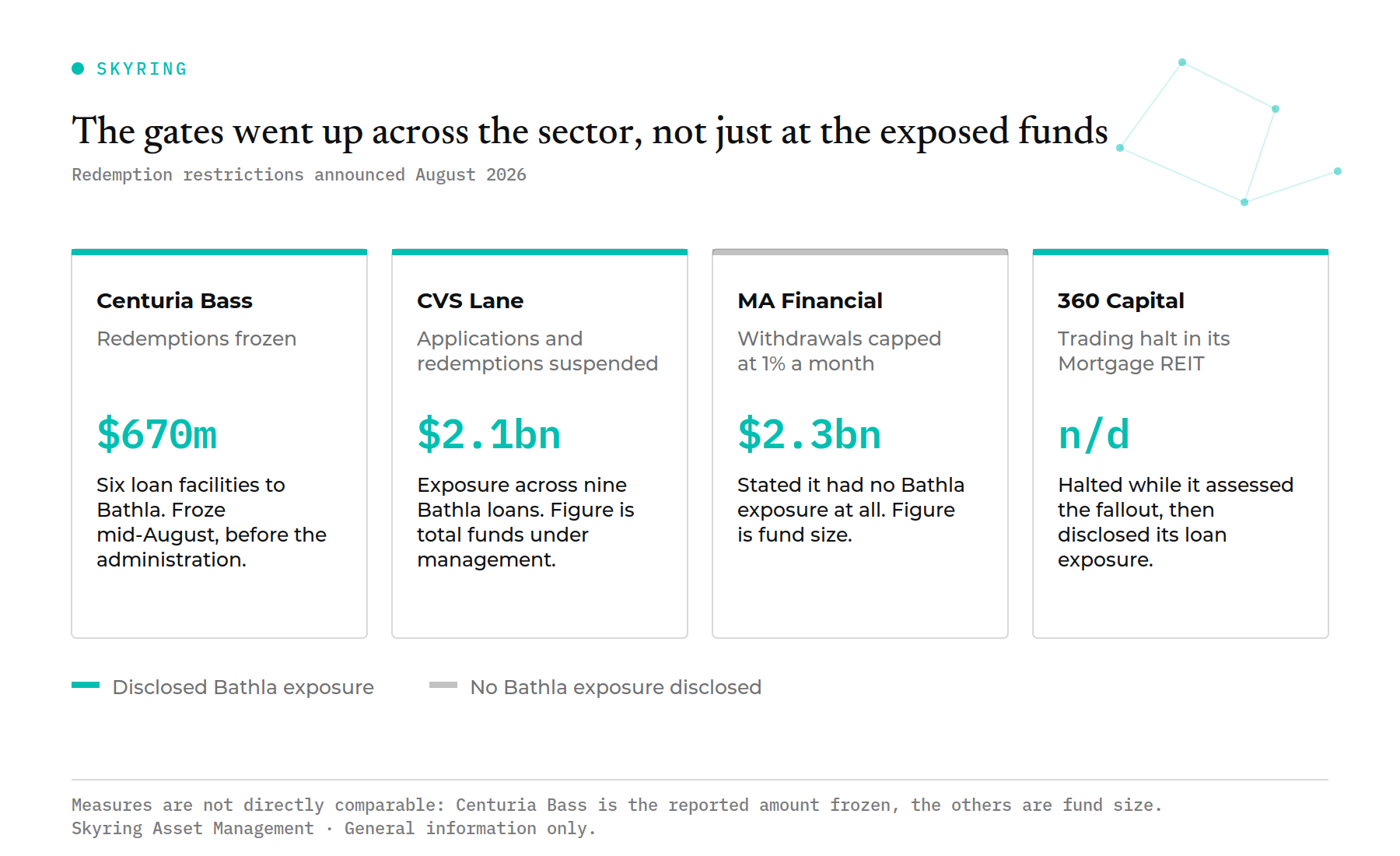
The fund investors. This is where the contagion showed up fastest, and where the losses may end up being about liquidity rather than credit. Centuria Bass froze roughly $670 million of redemptions across two funds in mid-August, before the administration. CVS Lane suspended applications and redemptions across two funds. 360 Capital briefly halted trading in its Mortgage REIT while it assessed the fallout. MA Financial capped withdrawals from its $2.3 billion real estate credit fund at 1 per cent a month while stating it had no Bathla exposure at all, which tells you the gates went up in response to investor behaviour rather than to a specific loan. La Trobe and Keyview have said they are not restricting redemptions.
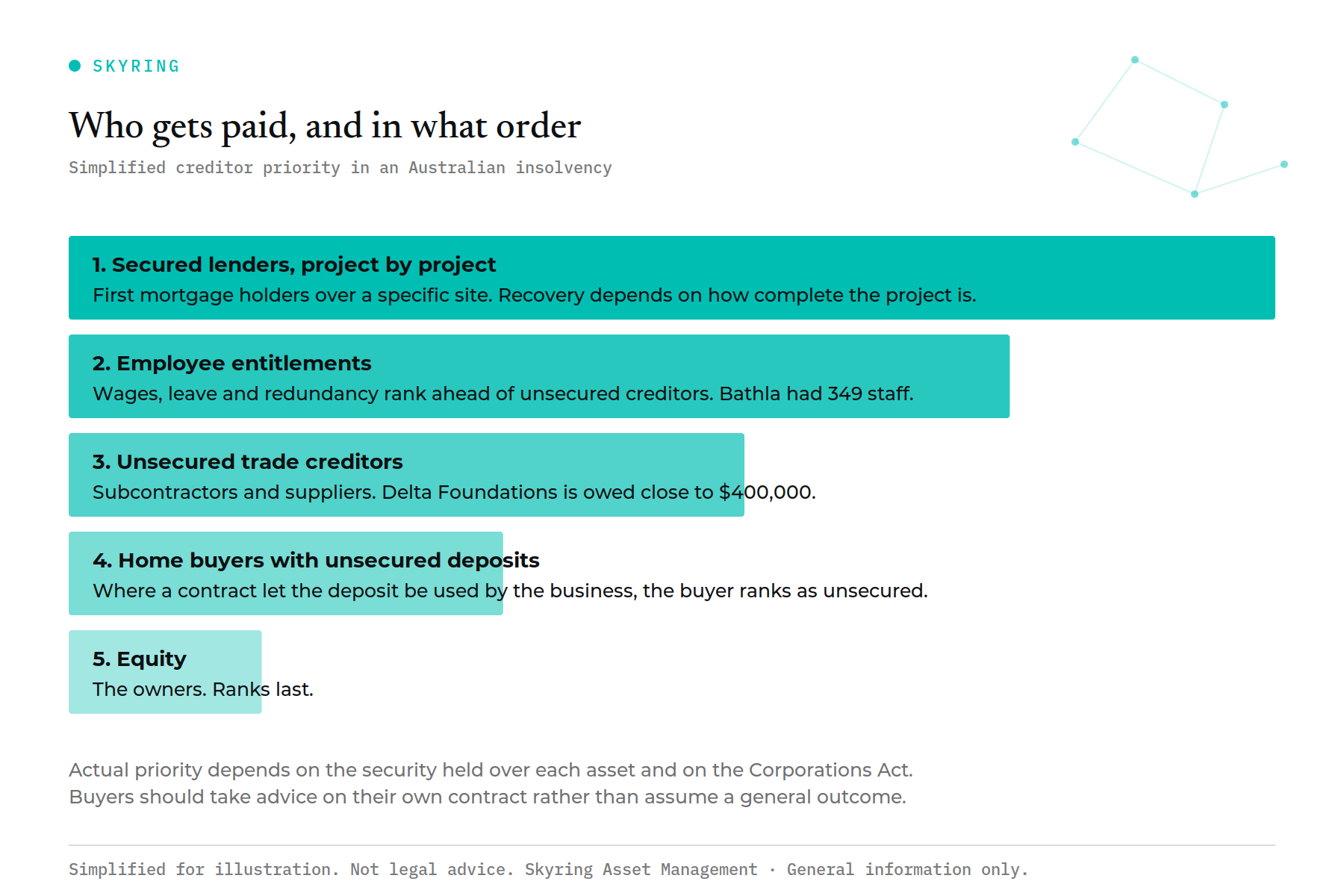
The subcontractors. Delta Foundations is owed close to $400,000 for work already done, as an unsecured creditor. That is one firm. There are hundreds. A joinery owner told the ABC he had a written commitment from PAG covering one site and nothing covering his other invoices, while he still owed the ATO, his suppliers and his own workers. Unsecured trade creditors sit at the bottom of the waterfall and generally recover cents.
The buyers. Administrators have said as many as 1,000 deposits may have been paid to the group, and that some contracts permitted those deposits to be used by the business, and that they were. Whether individual buyers get their money back or their house finished depends on the contract, the deposit’s location and whether the relevant lender chooses to fund completion of that specific site. Some lenders, PAG among them, have taken direct control of worksites and started paying trades themselves to protect their security.
The Evergrande question
Comparisons to Evergrande have been circulating, and they are worth testing rather than repeating.
The similarities are real enough at the level of mechanics. A developer scaled aggressively using expensive short-term debt against pre-sales, a slowdown in the underlying market broke the cash conversion cycle, and the failure exposed how much of the financing had been rolled rather than repaid. Both cases also show the same uncomfortable feature: the buyers who paid deposits are creditors of a company that has already spent the money.
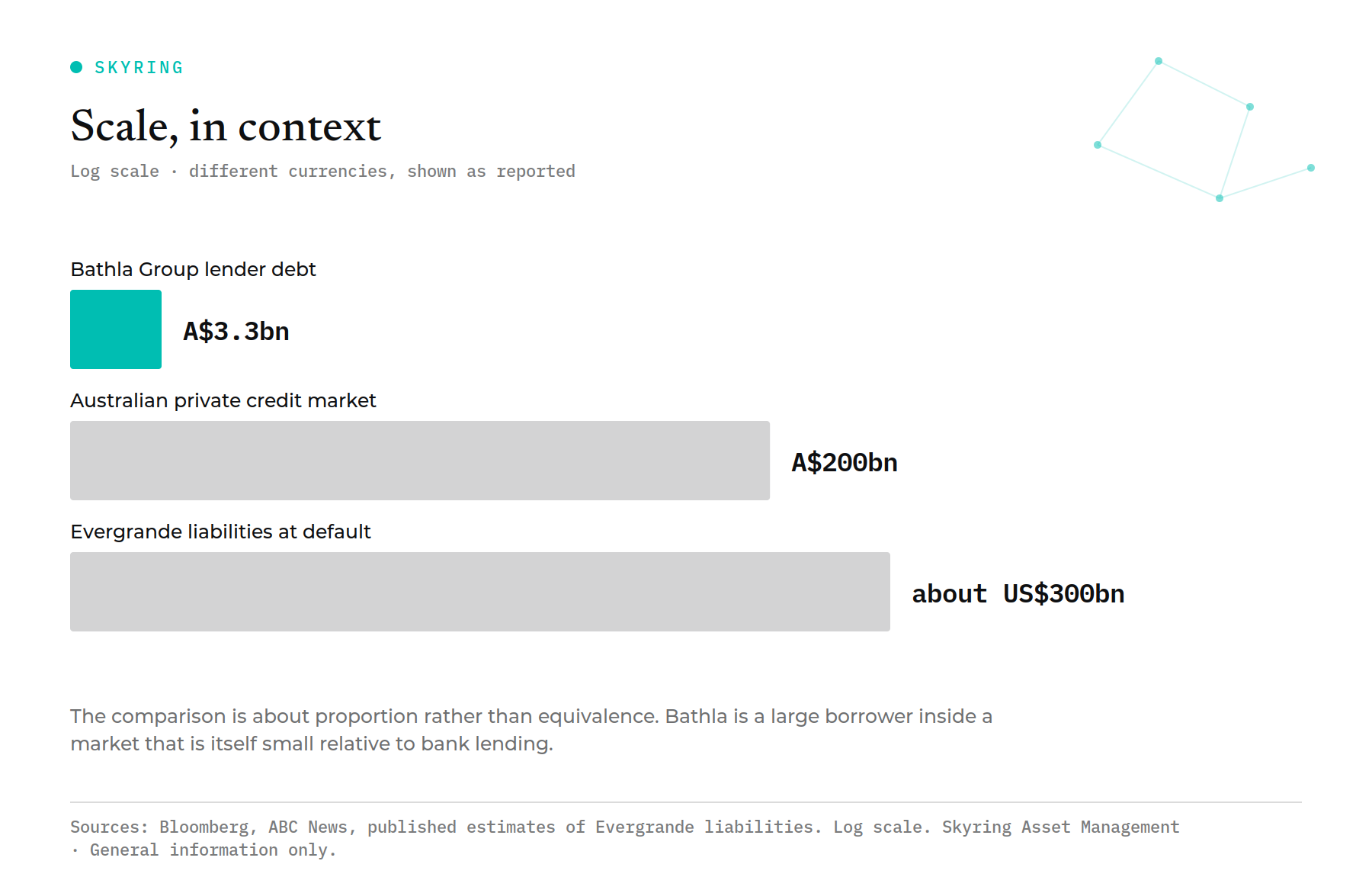
The differences matter more. Evergrande carried roughly US$300 billion in liabilities and sat inside a property sector that made up something close to a quarter of Chinese GDP, with local government finances structurally dependent on land sales. Bathla owes around $3.3 billion into a private credit market of roughly $200 billion, in a country where the four major banks still hold the overwhelming majority of property-related credit. The RBA has noted that non-bank lending to property development has grown faster than non-bank housing lending generally, while also assessing that the sector remains small enough that stress inside it would have limited systemic consequences.
Where the comparison earns its keep is in the second-order effect. Evergrande’s real damage to Chinese households came through confidence: buyers stopped committing to off-the-plan purchases because they no longer trusted that anything would get built. Australia’s housing supply targets rest on a construction industry that recorded more than 1,500 company failures in New South Wales alone last financial year. If buyers of new stock start pricing in completion risk, and if lenders start pricing in the cost of stepping into half-built sites, new supply gets harder and slower regardless of what the tax settings say.
Four things worth watching from here
Whether the frozen funds reopen on schedule
The single most useful indicator is not the outcome of the creditors’ meeting. It is whether Centuria Bass, CVS Lane and the others reopen redemptions on the timeframes they nominated. Gates that lift on time suggest a liquidity mismatch that has been managed. Gates that get extended suggest the underlying loans cannot be turned into cash at carrying value, which is a different and more serious problem.
Whether first mortgage security actually converts
Most of the Bathla debt is secured. Secured is not the same as recovered. The recovery number depends on how complete each project is, what a partly built site fetches when several come to market at once, and how much it costs to finish the work. Projects that are substantially complete should be fine. Raw land held against a loan written in a stronger market is the exposure to watch.
Whether construction credit reprices for everyone
Lenders have already tightened. The question is whether solvent developers with modest gearing and genuine pre-sales are now paying materially more, or being declined, because of what happened at one borrower. If so, the supply consequences arrive with a lag of twelve to eighteen months and show up as fewer starts rather than as headlines.
What ASIC does next
Multiple enforcement investigations were already underway before Bathla. The regulator has signalled that its 2026 work will focus on fees, margin structures and conflicts in wholesale funds, and on how private credit gets distributed to retail investors. Expect more disclosure, tighter definitions of terms like investment grade and senior debt, and possibly higher capital requirements for responsible entities.
What this means for your portfolio
1. Read the liquidity terms before you read the yield
The uncomfortable fact of the past fortnight is that at least one fund which capped withdrawals had no exposure to Bathla whatsoever. Its investors simply asked for their money at the same time, and the fund did the right thing by limiting exits rather than dumping assets at whatever price it could get. That is a defensible piece of fund management, and it is also a reminder that a monthly redemption window written against a two-year construction loan is a promise that depends on other people staying calm.
Go and find the actual withdrawal terms of every credit product you hold. How long does the manager have to pay you, what triggers a suspension, and what proportion of the fund can exit in a month. If the answer is buried, that is itself information. Skyring has written before about how to behave when markets turn, and the same principle holds in credit: the time to understand your exit is well before you want to use it.
2. Look through the headline rate to how the loan was underwritten
A 15 per cent return is a statement about risk, not about skill. Somebody was paid that rate because a bank would not write the loan.
The questions that matter are dull ones. What proportion of the fund sits with a single borrower or a single postcode. Whether construction loans are valued as-if-complete or on current state. Whether the people who approved the loan are the same people who value it now. Whether the manager has a written policy for what happens when a borrower asks for forbearance, and whether they have ever used it. ASIC found that fewer than half the funds it surveyed had that last one in writing. Those are questions any investor can put to a manager in an email, and the quality of the answer is usually more revealing than the number in the performance table.
It also matters whether the lending policy is genuinely restrictive rather than nominally so. Concentration limits that get waived for a large relationship borrower are not limits. Loan-to-value ratios calculated against optimistic future valuations are not ratios.
3. Diversify the credit you own, not just the assets
Most Australian investors think about diversification across shares, property and cash, and treat their income allocation as a single block. Bathla is an argument for looking inside that block.
If your defensive allocation is concentrated in residential construction lending, then it is not diversifying you away from property risk. It is the same exposure, expressed as debt, with the added feature that you are last to know when it deteriorates. The point of a defensive allocation is that it behaves differently to the growth side of the portfolio when conditions tighten, and that only happens if the underlying borrowers are genuinely different.
This is where actively managed fixed income earns its fee. Choosing exposures selectively across borrowers, sectors and maturities, holding a mandate that limits how much can sit with any single credit, and having the discipline to decline a loan when the price does not compensate for the risk. It is unglamorous during a boom, when the manager who says no is simply the manager returning less than the one who said yes. Its value shows up in weeks like this one. At Skyring, that discipline is the reason the Skyring Platinum Fixed Income Fund sets its credit criteria before it sets its target return rather than the other way around.
The bottom line
Bathla did not fail because of a single policy change or a single bad project. It failed because a business model that required continuous sales at scale met a market that stopped buying, while carrying a cost of debt that only made sense if the sales continued. Around forty lenders funded that model, several of them promising their own investors liquidity they could not deliver if enough people asked at once, and the regulator had described most of these weaknesses in writing before any of it happened.
For investors, the takeaway is not to avoid credit. Lending money to businesses at a fair price for the risk is one of the more reliable ways to generate income, and yields today are genuinely attractive. The takeaway is that the yield on a credit investment tells you almost nothing on its own. What tells you something is the borrower, the security, the concentration, the valuation method and the terms on which you can leave. Those things are knowable. They are just harder to put in an advertisement than a number with a percentage sign after it.
This article reflects information available as at 3 September 2026. The Bathla administration is ongoing and circumstances may change materially.
FAQ: The Bathla Group collapse
What is Bathla Group?
A Sydney-based residential property developer founded in 1997, operating principally through Universal Property Group and known for affordable housing across Sydney’s west and south-west, with projects also in regional NSW, South Australia and Victoria.
How much does Bathla owe?
Filings recorded approximately $3.2 billion in liabilities for Universal Property Group as at 30 June 2025. Reporting since the administration puts the amount owed to lenders at around $3.3 billion, with some estimates of total private credit debt higher again.
Who lent Bathla the money?
Around 40 private credit and non-bank lenders. Reported names include PAG, CVS Lane Capital Partners, Centuria Bass, Balmain, La Trobe Financial, Ray White Capital, Keyview, Trilogy, Credit Connect, MaxCap and Wingate. Exposures vary widely, from tens of millions to more than $300 million.
Does voluntary administration mean the projects won’t be finished?
No. Administration is a process for assessing whether a business can be saved. Several lenders have taken control of individual sites and are paying subcontractors directly to complete projects where their security is close to realisable. Creditors will vote on whether the companies are restructured under a deed of company arrangement or wound up.
What happens to buyers who paid deposits?
It depends on the individual contract. Administrators have indicated that up to 1,000 deposits may have been taken and that some contracts allowed the business to use those funds, which it did. Buyers should seek their own legal advice on their specific contract rather than assuming a general outcome.
Why did funds with no Bathla exposure limit withdrawals?
Because redemption requests surged across the sector on general concern about property development lending. A fund facing heavy withdrawals from an illiquid loan book can either sell assets cheaply or limit exits. Limiting exits usually protects remaining investors, which is why it happens.
Is this a systemic risk to the Australian financial system?
Current evidence suggests not. Private credit is roughly $200 billion in a financial system still dominated by bank lending, and the RBA has assessed that stress in the non-bank sector would have limited systemic impact. The more likely consequences are tighter construction finance and slower housing supply.
Does this mean private credit is a bad investment?
It means dispersion within the category is wide. ASIC’s own surveillance drew a distinction between institutional-grade operators with sound practices and segments of the market, particularly real estate construction finance sold to wholesale and retail investors, where governance and valuation practices were weakest. The category is not the answer. The specific manager and mandate are.
What should I be asking my fund manager?
Concentration by borrower and geography, how construction loans are valued, whether loan approval and valuation are separated, what the written default and impairment policy says, and the precise mechanics of redemption including suspension triggers.
References
- ABC News, Major NSW property developer Bathla Group enters administration, 25 August 2026.
- ABC News, Bathla Group needs $20 million to keep construction going as buyers and contractors wait, 27 August 2026.
- ABC News, Private credit firm CVS Lane joins list of firms limiting investor pullouts, 28 August 2026.
- ABC News, Bathla Group’s collapse may be imminent as funding deadline brought forward, 1 September 2026.
- ABC News, Bathla Group will meet its payroll obligations, 3 September 2026.
- Bloomberg, Insolvent Bathla faces 24-hour deadline for deal with creditors, 2 September 2026.
- Bloomberg, Builder’s bust jolts private lenders drawn by 15% yearly returns, 2 September 2026.
- Bloomberg via Insurance Journal, Sydney developer in distress sounds alarm for private credit, 31 August 2026.
- The Urban Developer, Urgent talks under way as overextended Bathla Group collapses, August 2026.
- Domain, Major Sydney property developer Bathla Group falls into administration, August 2026.
- Domain, Property developer Bathla Group on brink of collapse, administrator says, September 2026.
- Capital Brief, Private credit slams the gates shut as Bathla folds, August 2026.
- Financial Newswire, Centuria stands its ground on Bathla exposure, 24 July 2026.
- MacroBusiness, Alarm bells sound for Australia’s private credit market, August 2026.
- ASIC, ASIC puts private credit on notice, ahead of 30 June valuations and reporting, 18 June 2026.
- Ashurst, ASIC’s new enforcement priority on the private credit sector: what you need to know.
- Hall & Wilcox, ASIC’s private credit surveillance: key insights for retail and wholesale funds.
- Clayton Utz, ASIC’s private credit escalation, June 2026.
- GRM Law, ASIC REP 820 private credit surveillance obligations, June 2026.
- William Buck, Federal Budget analysis 2026: negative gearing, July 2026.
- Clayton Utz, Australian Budget 2026-27: sweeping tax changes to bring foreseeable and unintended consequences for investors, May 2026.
- The Good Builder, Private credit funds have restricted redemptions since before Bathla’s collapse, September 2026.
- ArayaPRO Supplier Risk Watch, Bathla collapse exposes downstream supplier and subcontractor risk, September 2026.
- Skyring Asset Management, The 2026 Federal Budget: what it means for your portfolio.
- Skyring Asset Management, How to survive a sharemarket crash.
- Skyring Asset Management, Is stagflation back? What the 1970s tell us about investing in 2026.
Skyring Asset Management has no association with Bathla Group, Universal Property Group, Raj & Jai Construction or any of their related entities, and is not a lender to them. Nothing in this article should be read as suggesting otherwise.
Important information
This blog post is for general information only and does not consider your personal circumstances, financial needs, or objectives. You should read the Product Disclosure Statement carefully before investing. Past performance is not a reliable indicator of future results. Investments carry risks including possible loss of capital. No guarantee is made regarding the repayment of capital or the payment of income.
As with all investments, returns are subject to market conditions and the performance of the underlying assets.
This rate of return is subject to the performance of our related entity, Skyring Capital Pty Ltd and/or Skyring Securities Pty Ltd.
You should consider whether the investments are suitable for you or seek personal advice from a licensed financial planner before making an investment decision.
To invest in this Offer, investors should obtain and read the PDS, SPDS and TMD before making an investment decision.
TMD, SPDS and PDS for this product are available from our website or request a copy by contacting us on 1300 73 72 74 or request one from your Financial Advisor. Investments may only be made by completing the application form attached to the Product Disclosure Statement or via our online application service.
Skyring Asset Management Limited ACN 156 533 041 holds Australian Financial Services License (AFSL) 422902. Skyring has registered the Skyring Fixed Income Fund ARSN 622 775 464 with the Australian Securities and Investments Commission (ASIC). Skyring Asset Management Limited ACN 156 533 041 AFSL 422902 is the issuer and manager of the Skyring Fixed Income Fund ARSN 622 775 464. Skyring has registered the Skyring Platinum Fixed Income Fund ARSN 646 317 982 with the Australian Securities and Investments Commission (ASIC). Skyring Asset Management Limited ACN 156 533 041 AFSL 422902 is the issuer and manager of the Skyring Platinum Fixed Income Fund ARSN 646 317 982.
Withdrawal rights are subject to liquidity and may be delayed or suspended. See PDS and SPDS for more information.
Skyring’s address is Level 2, 2 Gardner Close, Milton, QLD, 4064. Our reply-paid postal address is Reply Paid 88076, Kenmore, QLD 4069. You can contact us by telephone on 1300 73 72 74 or via email at investor@skyring.com.au.
1 Comment
-
Look at the ultimate owners – you’ll know WHY !