
Market insight · July 2026
Navigating economic uncertainty: why today's environment calls for strategic investing, not reactive decisions.
The economy is sending contradictory signals. That's not a reason to act quickly, it's a reason to check your portfolio was built for this.
In June, Australia's economy did two things that aren't supposed to happen together.
Employment rose by 76,000 — roughly five times what economists had forecast. And at the same time, national dwelling values fell 0.4 per cent, the steepest monthly decline since December 2022, with capital city home sales running around 16 per cent below where they were a year earlier.
Look closer, though, and even the strong number is equivocal. Of those 76,000 jobs, 47,000 were part-time, the underemployment rate rose to 6.5 per cent, and unemployment still ticked up to 4.4 per cent.
So the economy is strong. And the economy is weakening. Both readings are defensible, depending on which number you pick up.
For investors, this is disorienting — and the instinctive response is to reach for a decision. What should I sell? Where's the safe place to put this? Is now the time to get out of property, or into it?
Understandable questions. But they all assume the problem is timing.
A more useful question is this: has the economic environment fundamentally changed — and does my investment strategy still reflect that?
Because the honest answer, for most Australian portfolios, is that they were assembled under a set of conditions that no longer exists.
The setup
Why this environment is different from the one most portfolios were built for.
For roughly fifteen years, Australian investors operated inside a very particular set of rules.
Interest rates were low and falling. Borrowing was cheap. Cash and bonds paid close to nothing, which meant that anyone who needed income had little choice but to find it in shares and property. Asset prices rose more or less continuously, and the strategy that worked was straightforward: own growth assets, use leverage, and wait.
That environment has gone.
The RBA's cash rate target now sits at 4.35 per cent, following three increases since the start of this year. Headline inflation was 4.0 per cent in the year to May, with trimmed mean inflation — the measure that strips out the most volatile price movements — at 3.6 per cent and rising. Both sit above the Reserve Bank's 2–3 per cent target band. Australian 10-year government bond yields have been trading around 5 per cent, having touched their highest levels since 2011 earlier in the year.
Meanwhile, the Monetary Policy Board held rates in June, noting that financial conditions had tightened and the economy was slowing as expected — but that inflation remained too high. Market pricing currently implies a meaningful chance of a further increase before year end, while most bank economists don't expect cuts until 2027.
In other words: nobody credible is forecasting a return to the conditions of 2015–2021.
What this shows is that the shift isn't a market event to be traded around. It's a change in the underlying arithmetic — and the arithmetic is what portfolios are built on.
Real returns
Inflation is more than rising prices — it's a wealth problem.
Inflation is usually discussed in terms of the weekly shop and the price at the bowser. Those effects are real and immediate. But the more consequential effect for investors is quieter.
What matters to long-term wealth isn't your nominal return (i.e. the headline number on your statement). It's your real return — what's left after inflation has taken its share.
At 4 per cent inflation, an investment returning 4 per cent has preserved your capital and grown your wealth by precisely nothing. At 3 per cent, it's gone backwards. And because inflation compounds in the same way returns do, small gaps sustained over long periods do serious damage to purchasing power.
This is the part of the environment that tends to get underweighted. Investors watch for the dramatic risk — the crash, the correction, the headline — while the slower one works away quietly in the background. We've written before about how to think about sharemarket falls, and the lesson here is that the losses people fear most are rarely the ones that do the most damage.
That said, inflation at current levels is not a 1970s problem. Wage growth remains contained, unemployment is around 4.4 per cent, and inflation expectations — while elevated — have eased from earlier in the year. We looked at that comparison in detail in our piece on whether stagflation has returned, and the conclusion was that the risk has risen without becoming a foregone conclusion.
But remember: inflation doesn't have to be extreme to reshape portfolio construction. It only has to be persistent.
Property
What the property market is actually telling us.
Australian property has been the country's most trusted wealth-building asset for decades, and for good reason. But no asset class sits outside the economic cycle — and the data now points to a market in transition.
Two numbers are currently circulating, and both are correct. National dwelling values are still around 7.3 per cent higher than they were a year ago. And Cotality's national Home Value Index fell 0.4 per cent in June — its third consecutive monthly decline — leaving the index roughly 0.7 per cent below its March peak.
The reason they disagree is timing. An annual figure is a rear-view mirror; it's still carrying the strong run through most of 2025. A monthly figure tells you the direction of travel now. When a market turns, the annual number keeps looking healthy for a while after the monthly number has rolled over. That's the position we're in.
Across the combined capitals, values fell 1.3 per cent over the June quarter, led by Sydney (down 3.2 per cent) and Melbourne (down 2.6 per cent).
And the turn is broadening. The mid-sized capitals that carried the market through 2025 are decelerating: Adelaide finished June flat, Brisbane managed 0.3 per cent, and Perth — which was posting monthly gains above 3 per cent late last year — slowed to 0.7 per cent. Auction clearance rates have sat below 50 per cent since late May.
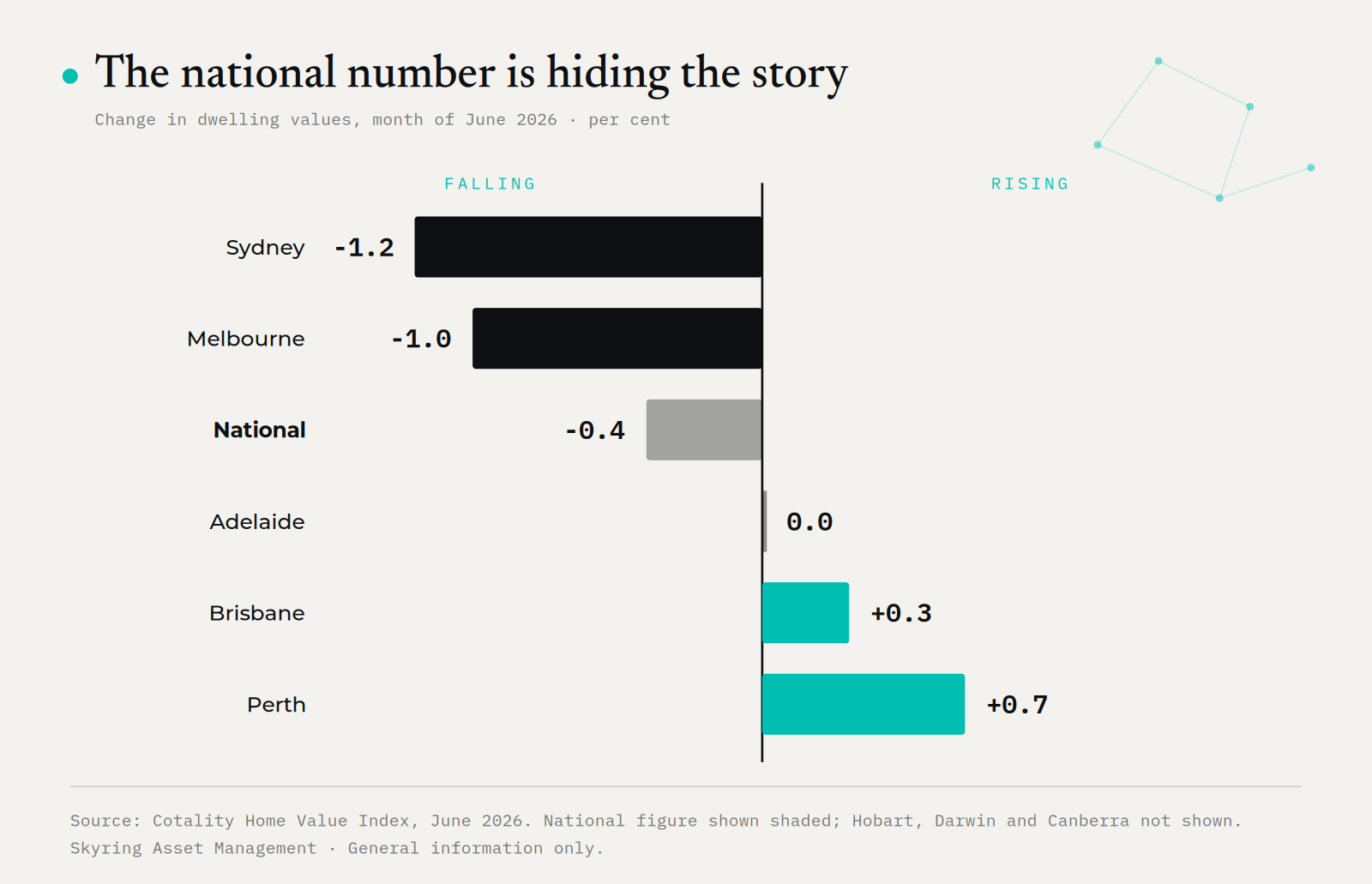
So is this a collapse? On the evidence, no. National values remain higher than a year ago, vacancy rates are tight at roughly 1.6 per cent, and rents are still rising at close to 6 per cent annually. This looks like a market cooling and fragmenting rather than breaking.
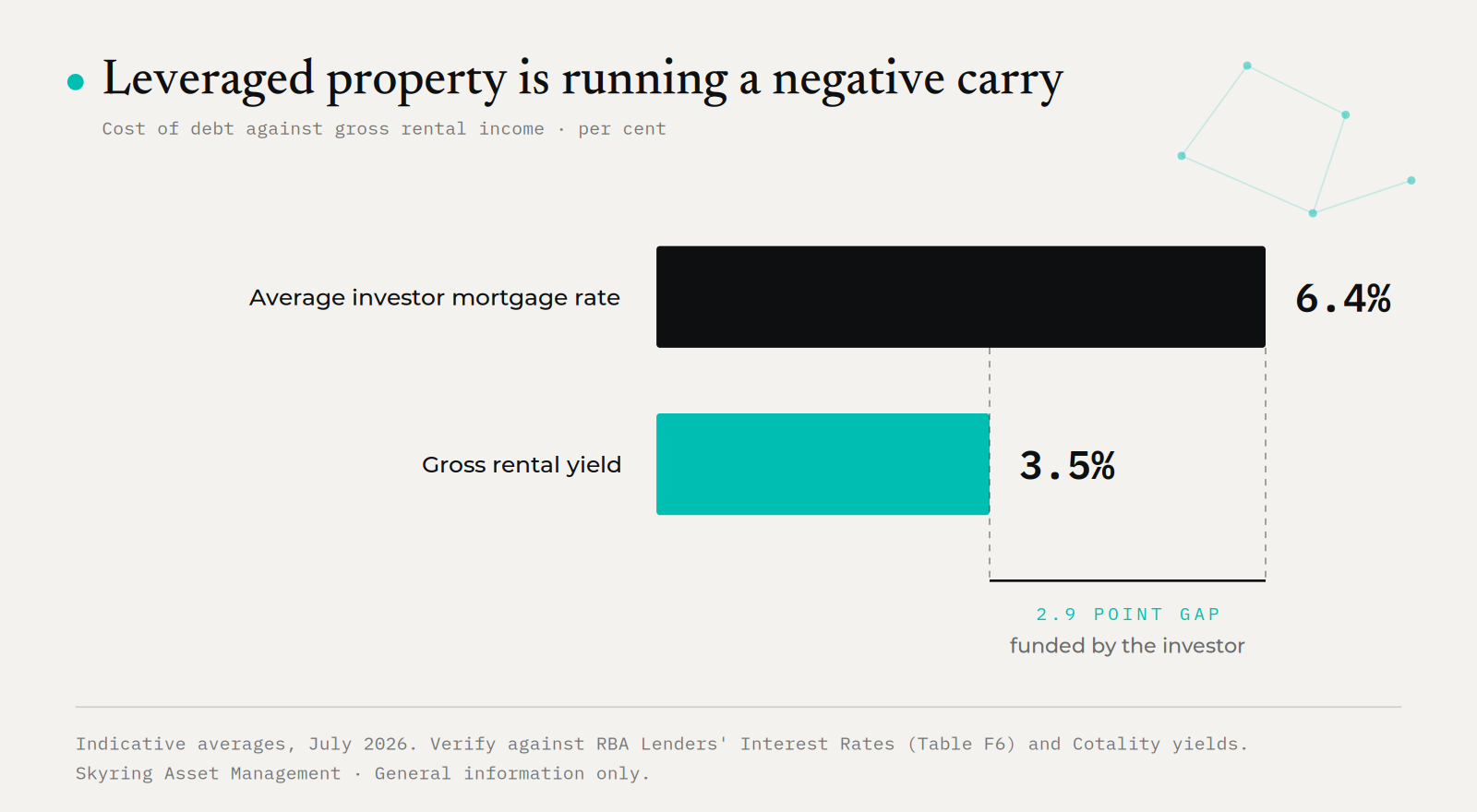
But the income arithmetic has become genuinely difficult. With investor mortgage rates averaging around 6.4 per cent against a gross rental yield of about 3.5 per cent, leveraged residential property is running a substantial negative carry — the holder is funding the gap out of other income and relying on capital growth to make the investment work.
Layered on top of that is a changed tax landscape. The 2026–27 Federal Budget introduced material changes to capital gains tax treatment and restricted negative gearing on established residential property, with the legislation passing the Senate in late June after amendments that included grandfathering for existing holdings and carve-outs for small business. We covered the detail separately, and the implications are specific to individual circumstances — which is precisely why this is territory for a conversation with your accountant or adviser rather than a blog post.
The lesson here isn't that property has stopped working. It's that property should be one component of a diversified strategy — not the strategy itself.
History
A useful comparison: the last time real yields existed.
There's a temptation, whenever conditions get strange, to reach for the most dramatic historical parallel available. The more instructive comparison here is a much less dramatic one.
Cast back to early 2008. The cash rate peaked at 7.25 per cent in March that year. Term deposits paid comfortably above 6 per cent. Government bonds delivered a real return without requiring any heroics. A diversified portfolio could meet a reasonable return objective without stretching for risk, because the defensive half of the portfolio was actually contributing.
Then the GFC arrived, rates collapsed, and by November 2020 the cash rate was 0.10 per cent — where it stayed until May 2022. Across that stretch, the defensive allocation stopped earning its keep. Investors who needed income had to manufacture it from somewhere else, which generally meant more equities, more property, more leverage, or more credit risk. An entire generation of portfolio construction was built on the assumption that there was no alternative.
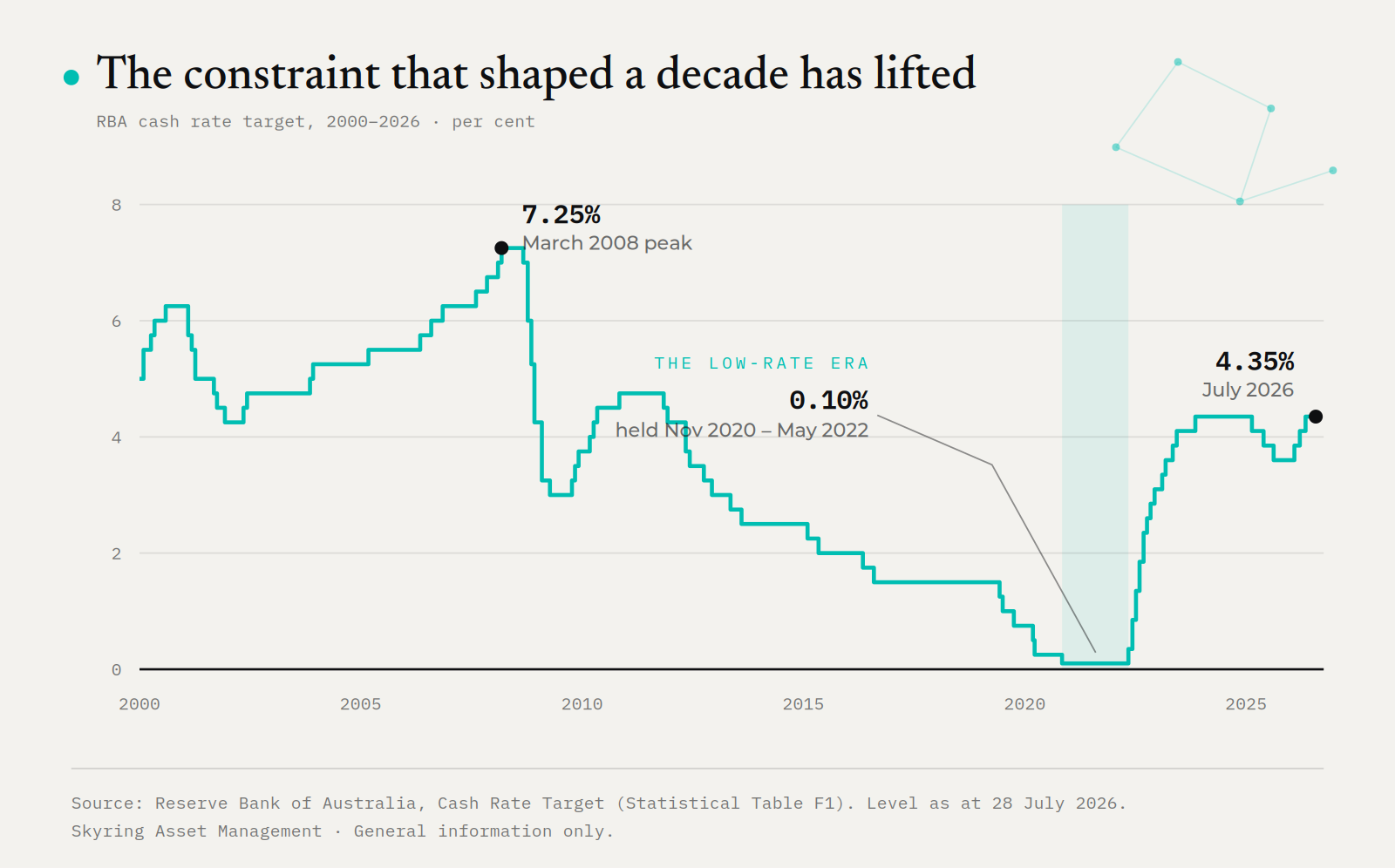
What's changed in 2026 is that the alternative is back.
The lesson here is not that the pre-GFC world has returned — it hasn't, and the inflation backdrop is materially worse. It's that the specific constraint that shaped fifteen years of Australian portfolio construction has been removed, and portfolios built around that constraint deserve a fresh look.
What's changed
Three shifts worth watching.
The rate path is no longer a one-way bet
For most of the past two decades, the direction of Australian interest rates was reasonably predictable over any twelve-month horizon. It isn't now. The Reserve Bank has explicitly said it is data-dependent, with the next decision due in August, and market pricing has moved repeatedly in both directions this year.
For investors, the practical consequence is that strategies dependent on a particular rate path — heavily leveraged positions, long-duration bets, valuations that only work if rates fall — carry more risk than they did in 2021.
The property cycle is normalising, and fragmenting
The national number is now hiding more than it reveals. Sydney and Melbourne are falling meaningfully. Perth, Brisbane and Adelaide are still growing, but slowing. Regional markets are mixed.
That fragmentation matters for anyone assessing concentration risk. A large, illiquid, leveraged, single-city property exposure is a very different proposition to a diversified property allocation — even though both appear on the same line of an asset allocation table.
Real yields have returned to fixed income
With 10-year Commonwealth government bond yields around 5 per cent and credit spreads adding to that, Australian fixed income is offering income above the current rate of inflation for the first time in a long while.
That's a structural change, not a tactical one. And it has direct consequences for how the defensive part of a portfolio should be built.
What to do
Three things to consider.
So what should you actually do? The temptation in an environment like this is to do something decisive. That's almost always the wrong instinct. But there are some considered steps worth thinking through.
1. Test your portfolio against this environment — not the last one
Start with the mechanical question rather than the emotional one. If your target allocation was set in 2019 or 2021, drift alone has probably moved you somewhere else — and the environment those targets were calibrated for has changed underneath them.
The specific things worth checking are your income requirements (can the portfolio meet them without selling assets at an inopportune moment?), your liquidity (how much of the portfolio could you access in ninety days?), your concentration (how much sits in one asset, one sector, one city?), and your genuine tolerance for volatility as opposed to your theoretical one.
For some investors, that review will point to change. For plenty of others, existing allocations will remain entirely appropriate. The objective isn't to reposition — it's to make sure the positioning is deliberate.
2. Let the defensive allocation do real work again
For fifteen years, the defensive sleeve of a typical Australian portfolio was essentially a drag to be minimised. It paid almost nothing, so investors held as little as they could tolerate and pushed the rest into growth assets.
That calculation has genuinely changed. When quality fixed income yields above the rate of inflation, the defensive allocation stops being insurance you pay for and starts being a contributor to return. And in an environment where growth assets face higher discount rates — meaning the same future earnings are worth less today — reliable income does more of the heavy lifting.
But how you access that income matters more than it used to. Duration (how long until a bond matures, and therefore how sensitive its price is to rate movements) is a live risk when the rate path is uncertain in both directions. Credit quality matters, because a slowing economy puts pressure on weaker borrowers — and a yield that looks attractive is sometimes just compensation for a risk that hasn't shown up yet. Which is the argument for actively managed fixed income over simply buying the index: selecting across maturities, borrowers and sectors, rather than accepting whatever the market happens to be issuing. The Skyring Fixed Income Fund is one way to access that approach.
3. Protect cash flow and liquidity before chasing return
This is the least glamorous consideration and often the most valuable.
Higher living costs and higher borrowing costs change investor behaviour in ways that show up on portfolio statements eventually. People pause contributions. They defer rebalancing. They draw down on savings earlier than planned. And sometimes they're forced to sell an asset at exactly the wrong moment — not because the investment thesis broke, but because the cash flow did.
So before optimising for return, make sure the structure holds: an adequate buffer, sufficient liquidity that you're never a forced seller, and enough flexibility that a rate rise or an unexpected expense doesn't require you to dismantle a long-term position. Resilience is boring right up until the moment it's the only thing that matters.
In summary
The bottom line: build for uncertainty, don't try to predict it.
Taken together, these factors suggest we're in a genuinely mixed environment — higher rates, stickier inflation and slower growth, but with a labour market that keeps surprising and, for the first time in years, defensive assets that actually pay something.
That combination doesn't lend itself to bold calls. Anyone claiming certainty about where inflation, rates or property prices land in twelve months is guessing with more confidence than the data supports.
But it does lend itself to structure. Wealth is rarely built by reacting to headlines — it's built through diversification across assets that don't all move together, periodic rebalancing so allocations don't drift, income generated through the cycle rather than harvested from capital growth, and enough liquidity to avoid ever being a forced seller.
Perhaps the most useful reframing is this: portfolios should evolve as markets evolve. The question isn't whether inflation, property or interest rates will dominate the next set of headlines. It's whether your strategy is robust enough that it doesn't much matter which one does.
Skyring Fixed Income Fund
Actively managed Australian fixed income, paid as regular monthly distributions. Speak with our Investor Relations team on 1300 73 72 74.
Questions
Frequently asked questions.
How does inflation affect long-term investment returns?
Why are investors reconsidering fixed income in 2026?
Should I move my investments out of property and into fixed income?
Are Australian property prices falling?
Why do annual and monthly house price figures tell different stories?
Is fixed income a good investment when inflation is high?
What does the 2026–27 Federal Budget mean for investors?
How often should I review my portfolio?
What's the most common investment mistake during uncertain periods?
Important information
This blog post is for general information only and does not consider your personal circumstances, financial needs, or objectives. You should read the Product Disclosure Statement carefully before investing. Past performance is not a reliable indicator of future results. Investments carry risks including possible loss of capital. No guarantee is made regarding the repayment of capital or the payment of income.
As with all investments, returns are subject to market conditions and the performance of the underlying assets.
This rate of return is subject to the performance of our related entity, Skyring Capital Pty Ltd and/or Skyring Securities Pty Ltd.
You should consider whether the investments are suitable for you or seek personal advice from a licensed financial planner before making an investment decision.
To invest in this Offer, investors should obtain and read the PDS, SPDS and TMD before making an investment decision.
TMD, SPDS and PDS for this product are available from our website or request a copy by contacting us on 1300 73 72 74 or request one from your Financial Advisor. Investments may only be made by completing the application form attached to the Product Disclosure Statement or via our online application service.
Skyring Asset Management Limited ACN 156 533 041 holds Australian Financial Services License (AFSL) 422902. Skyring has registered the Skyring Fixed Income Fund ARSN 622 775 464 with the Australian Securities and Investments Commission (ASIC). Skyring Asset Management Limited ACN 156 533 041 AFSL 422902 is the issuer and manager of the Skyring Fixed Income Fund ARSN 622 775 464. Skyring has registered the Skyring Platinum Fixed Income Fund ARSN 646 317 982 with the Australian Securities and Investments Commission (ASIC). Skyring Asset Management Limited ACN 156 533 041 AFSL 422902 is the issuer and manager of the Skyring Platinum Fixed Income Fund ARSN 646 317 982.
Withdrawal rights are subject to liquidity and may be delayed or suspended. See PDS and SPDS for more information.
Skyring's address is Level 2, 2 Gardner Close, Milton, QLD, 4064. Our reply-paid postal address is Reply Paid 88076, Kenmore, QLD 4069. You can contact us by telephone on 1300 73 72 74 or via email at investor@skyring.com.au.