Insights · October 2026
Debt or equity: which one are you actually holding?
The capital stack decides who gets paid and in what order. Debt is a contract for a number. Equity is a claim on whatever is left once every contract has been honoured. Plenty of investments sold as credit have quietly moved from the first category toward the second.

Skyring Asset Management
Skyring Asset Management · AFSL 422902

Sydney dwelling values finished September 8.6% below the peak they set in February this year. Melbourne sits 7.5% below its March 2022 high, Perth 6.0% below a peak it set in April. For anyone holding equity in a development priced off those earlier numbers, that fall has already happened to them. For a first mortgagee lending at 70% against the same building, nothing has happened at all yet.
Same asset. Same market. Two completely different years, and the reason is a decision made before construction started.
Part one of this series explained what your ranking buys you. Part two ran a single development through three endings and watched the money sort itself by position. Both pieces stayed inside the debt stack, arguing about which lender gets paid before which. This one closes the series by stepping back to the division underneath all of it, which is the line between lending money to a project and owning a piece of it.
What the capital stack actually decides
A property development is funded by money from several sources, and each source agrees in advance where it sits in the queue when the asset is sold. That queue is the capital stack. Debt occupies the bottom of it and gets paid first, in the order the lenders agreed between themselves. Equity sits at the top and gets paid last.
Put plainly: a lender is owed a number. Principal, interest at an agreed rate, and whatever costs the loan documents allow. That entitlement does not improve when the project does well and it does not shrink when the project does badly. It is a contract, and a contract is indifferent to the mood of the market.
Equity is the residual, which means it is a claim on the project's outcome minus every contracted entitlement ranking ahead of it. In a strong market that residual is the largest number in the deal and the equity holder makes multiples of what the senior lender makes on the same building. In a weak one it is zero, and zero arrives a long way before the first mortgagee has lost a cent.
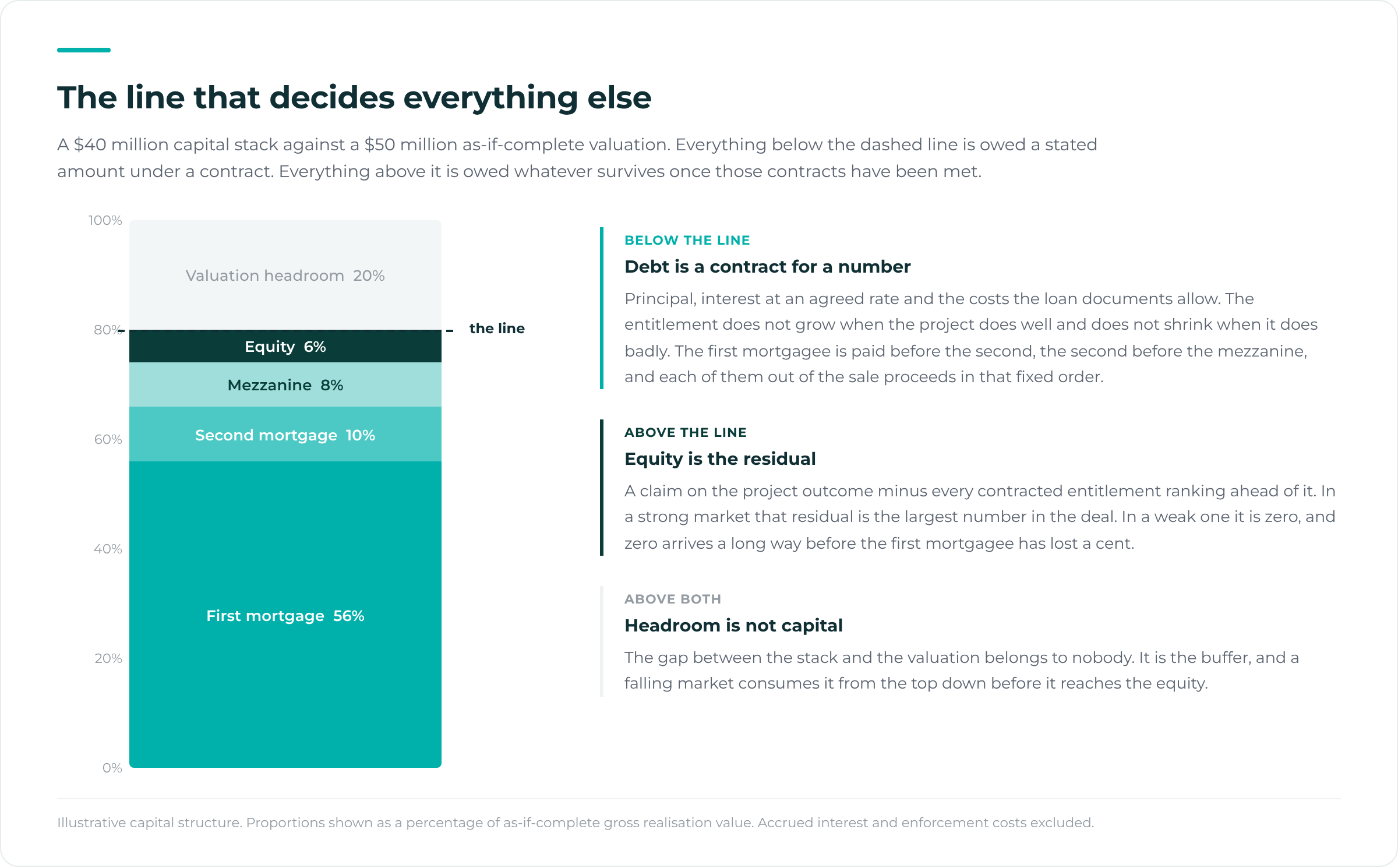
Figure 07. Every position below the line is owed a number. Everything above it is owed whatever survives.
Two terms worth defining because they do most of the work here. Lending valuation ratio (LVR) is the loan divided by the value of the security. Gross realisation value (GRV) is what the finished project is expected to sell for. A loan at 70% LVR against a $50 million GRV is $35 million of debt sitting beneath $15 million of equity, and that $15 million is the shock absorber for everyone underneath it.
The shape of the two returns
This is the part that gets described in words when it should be drawn. A lender's return is flat. It is the coupon, repeated, until either the loan is repaid or the security is worth less than the debt. An equity return is a slope, running from total loss at the bottom to uncapped at the top, pivoting on the point where the project breaks even.
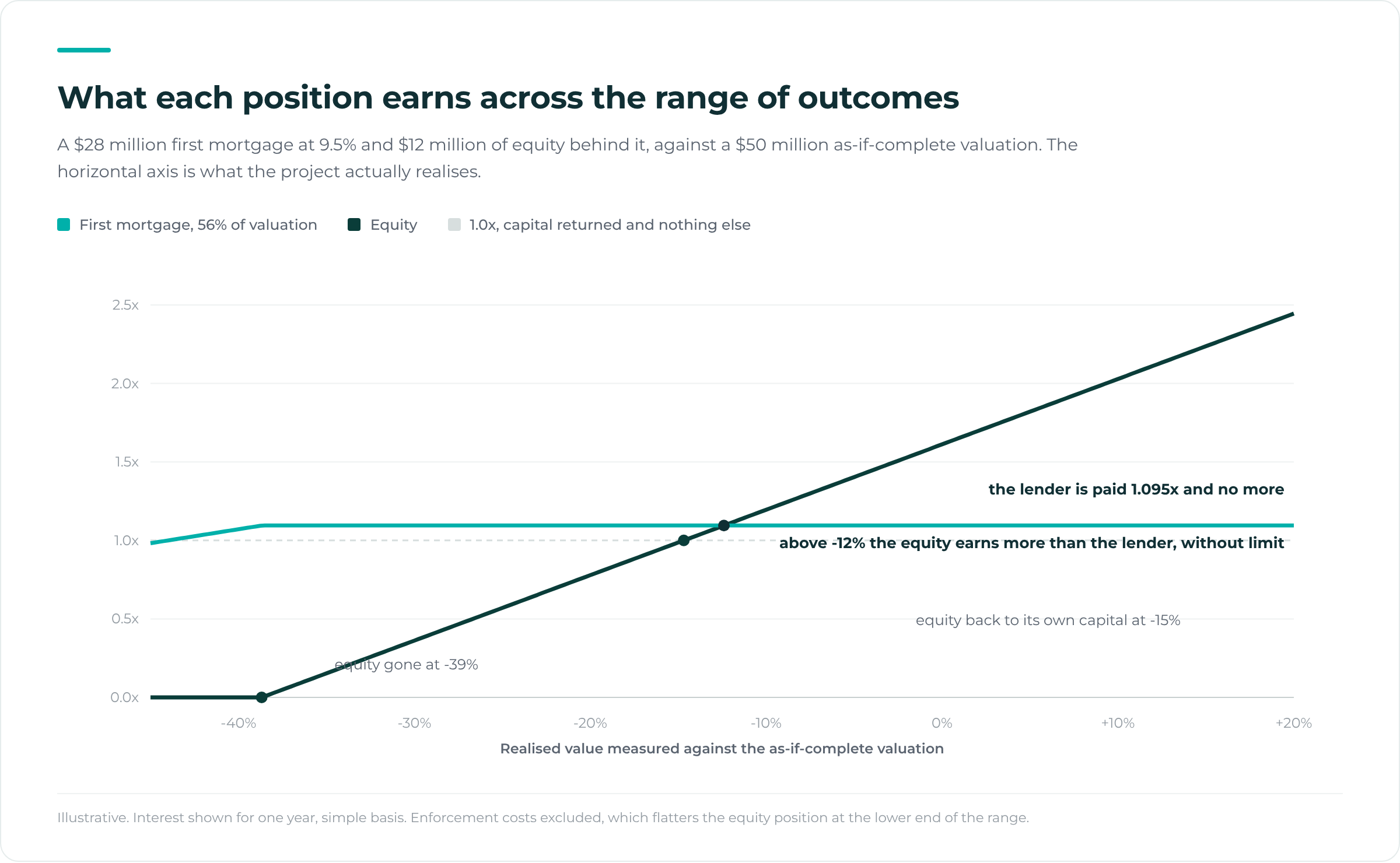
Figure 08. Illustrative. A 70% LVR senior loan and the equity beneath it, across a range of realised values.
Look at the left edge. The equity is wiped out by a 30% fall in realised value, at which point the senior lender is recovering its principal and has not yet taken a loss. Now look at the right edge, because an article that only shows the left edge is selling something. A 30% uplift doubles the equity holder's money and pays the lender exactly the coupon it was always going to be paid. The lender gave that upside away deliberately and permanently.
Neither line is the better investment. They are answers to different questions, and the error is holding one while believing you hold the other.
We have watched the line hold before
The Australian experience between 2008 and 2011 is the cleanest local test. Mortgage funds, property syndicates and development vehicles all froze at once and were all described at the time as the same event. They were not. The vehicles that returned capital in full were overwhelmingly those holding first-ranking debt against completed, income-producing property. The syndicates holding the equity in those same buildings returned fractions, and in a number of cases nothing. The managers were not uniformly worse. Their positions were.
Evergrande made the point on a scale Australia has never seen, and made a subtler version of it. The group's offshore bondholders thought they held debt, and they did. What they discovered on liquidation was that their claim sat structurally behind the onshore secured creditors who held direct claims over the project companies and the land. Recovery estimates for that offshore paper fell to the low single digits of cents in the dollar. Holding a debt instrument is not the same as holding the debt that sits closest to the asset, and the fat coupon those bonds paid for years was the market pricing a distance most holders had not measured.
Closer to home, the Bathla collapse left around $3.4 billion owed to roughly forty lenders. That recovery will sort itself by position before it sorts itself by anything else, and it will take years.
Two ways a credit investment starts behaving like equity
The line in Figure 07 is clear on paper. In practice it has become blurred, and an investor can hold something marketed as credit whose return profile has drifted toward the slope rather than the flat line. Two versions of this are common enough to be worth knowing by sight.
The buffer gets priced away
A loan written at a high enough LVR, against an optimistic as-if-complete valuation, has an equity risk profile wearing a debt label. The arithmetic is unforgiving. At 70% there is 30% of value between the lender and the first dollar of loss. At 85% there is 15%, and 15% is inside the range that Australian capital city values have moved in the last eighteen months. The instrument is still legally a loan. Its behaviour in a downturn is no longer a lender's behaviour.
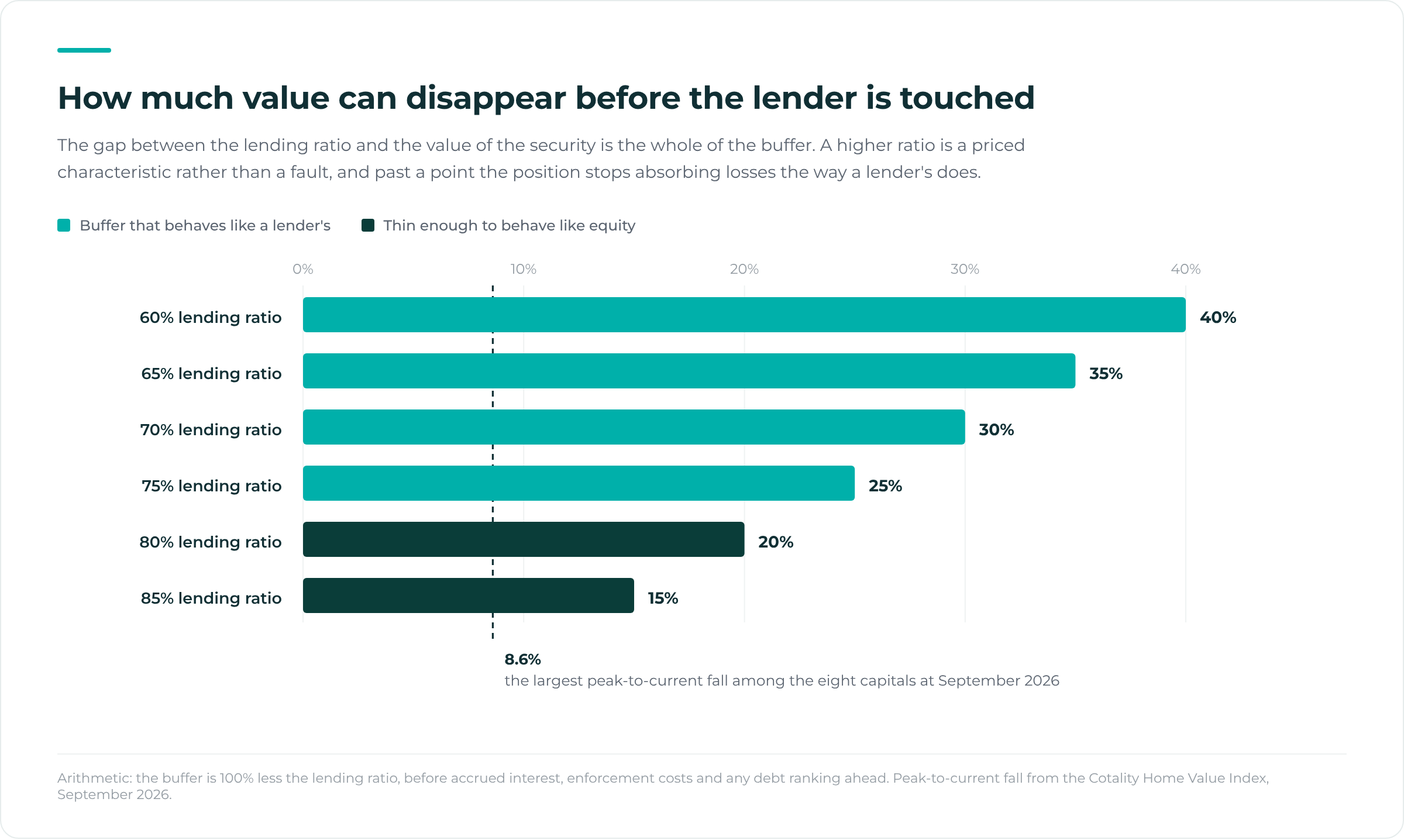
Figure 09. The buffer at each lending ratio, with the largest peak-to-current fall among the capitals this cycle marked for scale.
This is also why the valuation basis matters more than the ratio. A 70% LVR struck only on an as-if-complete figure is a buffer measured against a market that has not happened yet, and the headroom in the chart above is headroom against a number somebody estimated rather than a number anybody has paid.
The return gets a slope attached
Profit shares, participation fees and equity kickers attached to a loan convert part of the return into a claim on the project's outcome. There is nothing improper about this and it is disclosed in the loan documents. What it does is give the investor a piece of the upside in exchange for correlation they may not have wanted, and it tends to appear in exactly the deals where the sponsor could not pay a market coupon in cash.
What this means for your portfolio
1.
Answer the three questions this series has given you
Take the offer document rather than the fact sheet and find the lending policy. It tells you what the fund is permitted to do, which matters considerably more than what it happens to be doing this quarter. Three answers sit in there. Where the fund ranks. What the maximum lending ratio is and which valuation basis it is struck on. Whether the return includes any participation in project outcomes.
The language is precise once you know what to read for. The Skyring Fixed Income Fund PDS states that Skyring Capital will only provide first-ranking or senior debt loans and will not provide second-ranking or mezzanine loans, with a maximum LVR of 70% on both an as-is and an as-if-complete basis, all loans secured by a registered first mortgage over real property or a first ranking general security interest. The Skyring Platinum Fixed Income Fund is a different instrument by design and says so, permitting senior and mezzanine lending to a maximum LVR of 80% on an as-is and an as-if-complete basis and counting any prior ranking debt when calculating its own ratio. Two funds from the same manager, two positions, both written down.
If the fund you own cannot produce equivalent sentences from its own documents, the absence is itself the answer.
2.
Ask what the buffer is measured against, and when it was last looked at
A lending ratio is a fraction, and the half of it that does the work is the denominator. Ask which valuation basis the quoted figure is struck on, whether it uses the drawn balance or the approved limit, and whether debt ranking ahead of the fund is counted in the calculation. A ratio that looks conservative on one convention can be ordinary on another, and both numbers have appeared in Australian marketing material describing the same loan.
Then ask about vintage, which almost nobody does. A 65% ratio struck against a valuation done two years ago, in a market where capital city values have been falling for most of this year, is not a 65% ratio today. What you want to know is how often valuations are refreshed, whether there is a trigger obliging a revaluation when the manager forms a view that value may have fallen, and whether valuers are rotated so the same firm is not marking its own work across a decade of a relationship.
These sound like operational details and they are the whole of the buffer. The Skyring funds commit to independent valuations before advance, on any renewal beyond six months, and within two months of forming a view that a material decline may have occurred. Whatever you hold, that is the shape of the answer you are looking for.
3.
Stop counting the residual as defensive
The defensive part of a portfolio exists to hold its value and keep paying when the growth assets are having a poor year. That is the entire job. A residual claim fails it by construction, because the residual disappears in precisely the conditions the defensive allocation was built to survive. Holding equity exposure is a perfectly reasonable decision. Filing it under the defensive heading is a category error, and it is the most common one in Australian portfolios right now.
This is the practical case for actively managed fixed income rather than a yield number chosen off a comparison table. The work a lending policy does, ranking discipline, valuation independence, a published LVR cap on a stated basis and a clear position on what the fund may and may not do, is the work that keeps an instrument on the flat line when the market tests it. A passive holding cannot do that work, and a yield figure on its own tells you nothing about whether anybody did.
Skyring's comparison of government bonds, corporate bonds and secured lending sets out how these sleeves behave against each other, which is the next question once you know which line you are on.
The bottom line
Across three articles this series has worked through where you sit in the capital stack, what your ranking actually buys you, and now the line between lending money to a project and owning a piece of it. Together they add up to a toolkit: the kind of risk a fund exposes you to, your position in the queue when the asset is finally sold, and how much of the underlying value can disappear before any of it reaches you. Three questions, all of them answerable from documents you already have access to.
None of these positions is right or wrong. A first mortgage, a mezzanine loan and a direct equity holding are different instruments doing different jobs, and a portfolio with a sensible shape often contains more than one of them. What matters is knowing what each slice was bought to provide, the conditions in which it does that well, and the conditions in which it will disappoint you. An investor who can say that about every holding is in a considerably better position than one picking the highest number off a comparison table.
Which makes it worth being specific about when the fixed income slice earns its keep, because it is rarely the part of a portfolio that leads. Through a long rising market it tends to be the least interesting line on the statement. Its work shows up when growth assets are falling. Contracted interest keeps arriving on a schedule while equity distributions are being cut or suspended, and that income comes from borrowers meeting loan obligations rather than from a market agreeing on a price. The practical benefit of that shows up somewhere other than the yield figure. An investor still receiving income is under far less pressure to sell growth assets into a weak market to fund living costs or a redemption, and avoiding that sale is often worth more over a full cycle than the extra percentage point that tempted somebody into a thinner position. That is the moment a defensive allocation pays for all the years in which it looked dull.
Skyring is built for that job. Competitive returns with a conservative risk profile, first-ranking security over real property, lending ratios published on a stated valuation basis, and a loan book that is actively managed rather than left to run. It is a long way from the most exciting thing in a portfolio, and that is rather the point of it.
The capital stack is not complicated once somebody draws it, and most investors have simply never been shown. If this series has done its job, you can now open your own offer documents, find your position inside a few minutes, and decide whether it is the one you meant to buy. Knowing the answer will not change what the market does next. It will change how much of what the market does next lands on you.
FAQ
+What is the difference between debt and equity in a property development?
Debt is a contractual entitlement to a stated amount, principal plus interest at an agreed rate. Equity is a claim on whatever remains after every lender has been paid in full. Debt is repaid first and equity last.
+If equity is riskier, why would anyone take it?
Because the residual is uncapped. When a project performs, the equity holder keeps the surplus after the lenders have been paid their fixed entitlement, which can be several times the lender's return on the same building. The position is designed to be rewarded in good markets and wiped out in bad ones.
+Can a loan behave like equity?
Yes. A loan written at a high LVR against an optimistic valuation has very little buffer beneath it, so its losses begin at a point closer to the equity holder's than to a conservatively geared lender's. A loan carrying a profit share or participation feature also takes on equity characteristics by design.
+Where do I find my fund's position in its documents?
The lending policy section of the PDS, usually within the first third of the document. Read what the fund is permitted to do rather than what the current portfolio looks like, because the permission is what governs future lending.
+Is a high LVR always a problem?
No. It is a smaller buffer, which is a priced characteristic rather than a flaw. It becomes a problem when the investor has not registered that the buffer is smaller, or when the ratio is struck only against an as-if-complete valuation in a market where values are falling.
+Does this mean I should avoid property equity entirely?
That is a question about your own circumstances and objectives and this article cannot answer it. The narrower point is that a residual claim does the job of a growth asset rather than a defensive one, and it should be counted accordingly.
+Are the figures in the charts from a real project?
No. Figures 07 and 08 are illustrations built on round numbers to show the mechanics. The relationships they describe, the order of payment and the shape of each return, are how these transactions actually work.
References
- Skyring Asset Management, Where in the capital stack are you actually sitting?, 23 October 2026, incorporating Cotality Monthly Housing Chart Pack, October 2026.
- Skyring Asset Management, First mortgage, second mortgage and mezzanine: what your ranking actually buys you, 25 September 2026.
- Fortune, Evergrande liquidation leaves offshore bondholders facing near-total haircut, 8 February 2024.
- Skyring Asset Management, What happened to Bathla?, 31 August 2026.
- Skyring Asset Management, Corporate Bonds vs Government Bonds vs Secured Lending, 26 May 2026.
- Skyring Asset Management, Skyring Fixed Income Fund Product Disclosure Statement, lending policy section.
- Skyring Asset Management, Skyring Platinum Fixed Income Fund Product Disclosure Statement and Supplementary PDS, lending policy section.
- Reserve Bank of Australia, Financial Stability Review, October 2026.
Note on the illustrations. Figures 07 and 08 use a $50 million gross realisation value and the capital structure shown in each. Interest and enforcement costs are excluded for legibility, which flatters the equity position at the lower end of the range. Figure 09 shows the arithmetic difference between the lending ratio and 100%. Figures are computed from the stated inputs and are reproducible.
Important Information
This blog post is for general information only and does not consider your personal circumstances, financial needs, or objectives. You should read the Product Disclosure Statement carefully before investing. Past performance is not a reliable indicator of future results. Investments carry risks including possible loss of capital. No guarantee is made regarding the repayment of capital or the payment of income.
As with all investments, returns are subject to market conditions and the performance of the underlying assets.
This rate of return is subject to the performance of our related entity, Skyring Capital Pty Ltd and/or Skyring Securities Pty Ltd.
You should consider whether the investments are suitable for you or seek personal advice from a licensed financial planner before making an investment decision.
To invest in this Offer, investors should obtain and read the PDS, SPDS and TMD before making an investment decision.
TMD, SPDS and PDS for this product are available from our website or request a copy by contacting us on 1300 73 72 74 or request one from your Financial Advisor. Investments may only be made by completing the application form attached to the Product Disclosure Statement or via our online application service.
Skyring Asset Management Limited ACN 156 533 041 holds Australian Financial Services License (AFSL) 422902. Skyring has registered the Skyring Fixed Income Fund ARSN 622 775 464 with the Australian Securities and Investments Commission (ASIC). Skyring Asset Management Limited ACN 156 533 041 AFSL 422902 is the issuer and manager of the Skyring Fixed Income Fund ARSN 622 775 464. Skyring has registered the Skyring Platinum Fixed Income Fund ARSN 646 317 982 with the Australian Securities and Investments Commission (ASIC). Skyring Asset Management Limited ACN 156 533 041 AFSL 422902 is the issuer and manager of the Skyring Platinum Fixed Income Fund ARSN 646 317 982.
Withdrawal rights are subject to liquidity and may be delayed or suspended. See PDS and SPDS for more information.
Skyring's address is Level 2, 2 Gardner Close, Milton, QLD, 4064. Our reply-paid postal address is Reply Paid 88076, Kenmore, QLD 4069. You can contact us by telephone on 1300 73 72 74 or via email at investor@skyring.com.au.